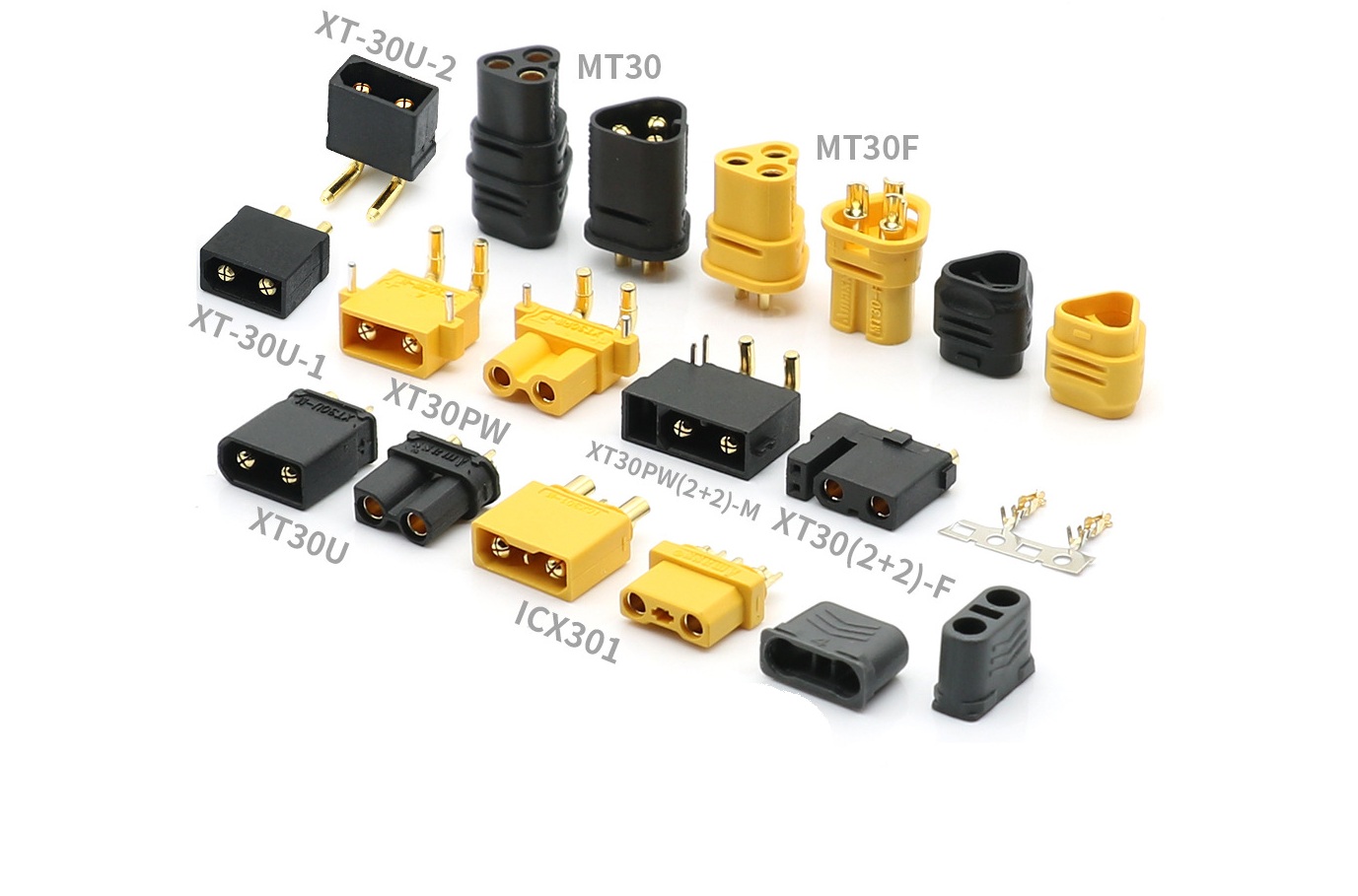
The Comprehensive Guide to XT Power Connectors: XT30, XT60, and XT90
XT connectors are widely recognized as the industry standard for high-current, low-to-medium voltage DC power distribution. Originally engineered and patented by Amass (Changzhou Amass Electromechanical Co., Ltd.), these connectors revolutionized the radio control (RC) hobby by replacing older, less reliable alternatives like Dean's T-plugs and legacy bullet connectors. Today, their usage extends far beyond model aircraft, anchoring applications in FPV drones, e-bikes, robotics, portable power stations, and solar systems.
Before the introduction of the XT series, RC enthusiasts and electronics tinkerers relied heavily on standard Deans Ultra Plugs, Tamiya connectors, or loose gold-plated bullet connectors soldered together with heat shrink. While Deans plugs handled moderate current, they were notoriously difficult to grip with fingers (especially cold hands or greasy fingers in the field), prone to wearing out, and tricky to solder without melting the plastic housing.
1. Origin & Historical Context
Recognizing the market's need for a polarized, high-current, ergonomically friendly, and durable connector, Amass designed the XT series (starting famously with the XT60). The letters "XT" stand for "X-Terminal" or cross-terminal family design, optimized for secure mating and low electrical resistance. Over time, the family expanded downward to the micro XT30 for lightweight FPV builds, and upward to the heavy-duty XT90 for large-scale electric aircraft and high-power industrial applications.
2. Core Advantages of XT Connectors
- Polarized Design (Anti-Reverse Polarity): The unique geometric trapezoidal housing shape makes it physically impossible to plug a battery in backward, preventing catastrophic short circuits and fried electronics.
- Low Contact Resistance: Genuine XT connectors utilize gold-plated spring-bullet contacts (typically brass/copper alloy with high-purity gold flash), yielding a very low contact resistance (typically <0.5 mΩ). This minimizes voltage sag and resistive heat buildup under load.
- Ergonomics & Grip: Unlike slick or flat plugs, the molded nylon housings feature ridges, ribbed textures, or ergonomic flanges (such as the "H" variants like XT60H) that give fingers a secure, slip-resistant grip when mating or un-mating high-retention connections.
- High-Temperature Resilience: Genuine housings are molded from high-temperature engineering thermoplastics (such as high-grade Nylon/PA), preventing the housing from warping or melting during high-heat soldering tasks.
- Durability: Rated for an impressive 1,000x mating lifecycle under normal operational conditions. They are rated up to DC 500V.
3. Technical Breakdown: XT30, XT60, and XT90 Specifications
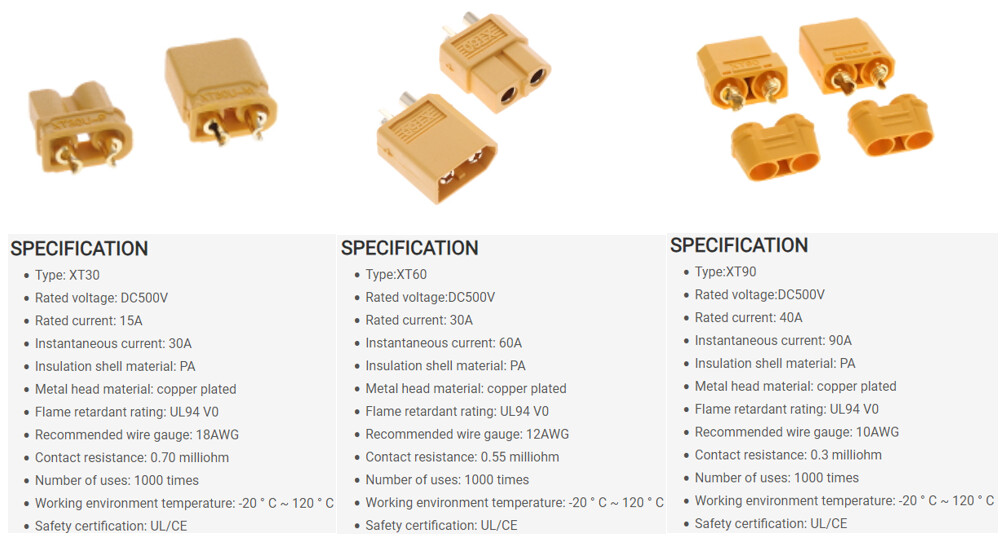
| Specification | XT30 | XT60 / XT60H | XT90 / XT90-S (Anti-Spark) |
|---|---|---|---|
| Continuous Current | 15A Continuous (30A Peak) | 30A Continuous (60A Peak) | 40A Continuous (90A+ Peak / 150A+ Burst) |
| Pin / Contact Diameter | 2.0 mm | 3.5 mm | 4.5 mm |
| Recommended Wire Gauge | 14-18 AWG | 10-12 AWG | 8-10 AWG |
| Housing Dimensions | ~13 x 10.2 x 5.4 mm | ~20-21 x 16 x 8.0 mm (Mated: ~24mm) | ~20-25 x 21 x 11 mm |
| Weight (Pair) | ~2.3 g | ~9.5 g | ~18 g (Standard) / ~22 g (Anti-Spark) |
| Special Features | Ultra-lightweight; requires heat shrink on solder cups. | Textured housing ribs; "H" variant adds snap-on protective backshells. | Available with built-in anti-spark resistors (XT90-S); includes slip-on backshell wire insulators. |
4. Special Variants: XT60H and XT90-S
- XT60H ("H" for Housing/Backshell): Addresses the traditional need for heat shrink tubing by including a snap-on plastic end-cap cover that conceals the soldered solder cups, offering a clean, professional finish without exposed copper.
- XT90-S (Anti-Spark): High-voltage systems (like 6S to 12S LiPo packs operating at 22.2V to 44.4V+) experience a massive in-rush current spike when plugged in, creating a loud pop, pitting the gold pins, and degrading ESC input capacitors. The XT90-S integrates a built-in pre-charge resistor ring on a specialized tip that dampens the initial spark before fully seating into the low-resistance main contacts.
5. Comparison: XT Connectors vs. EC Connectors (EC3 / EC5)
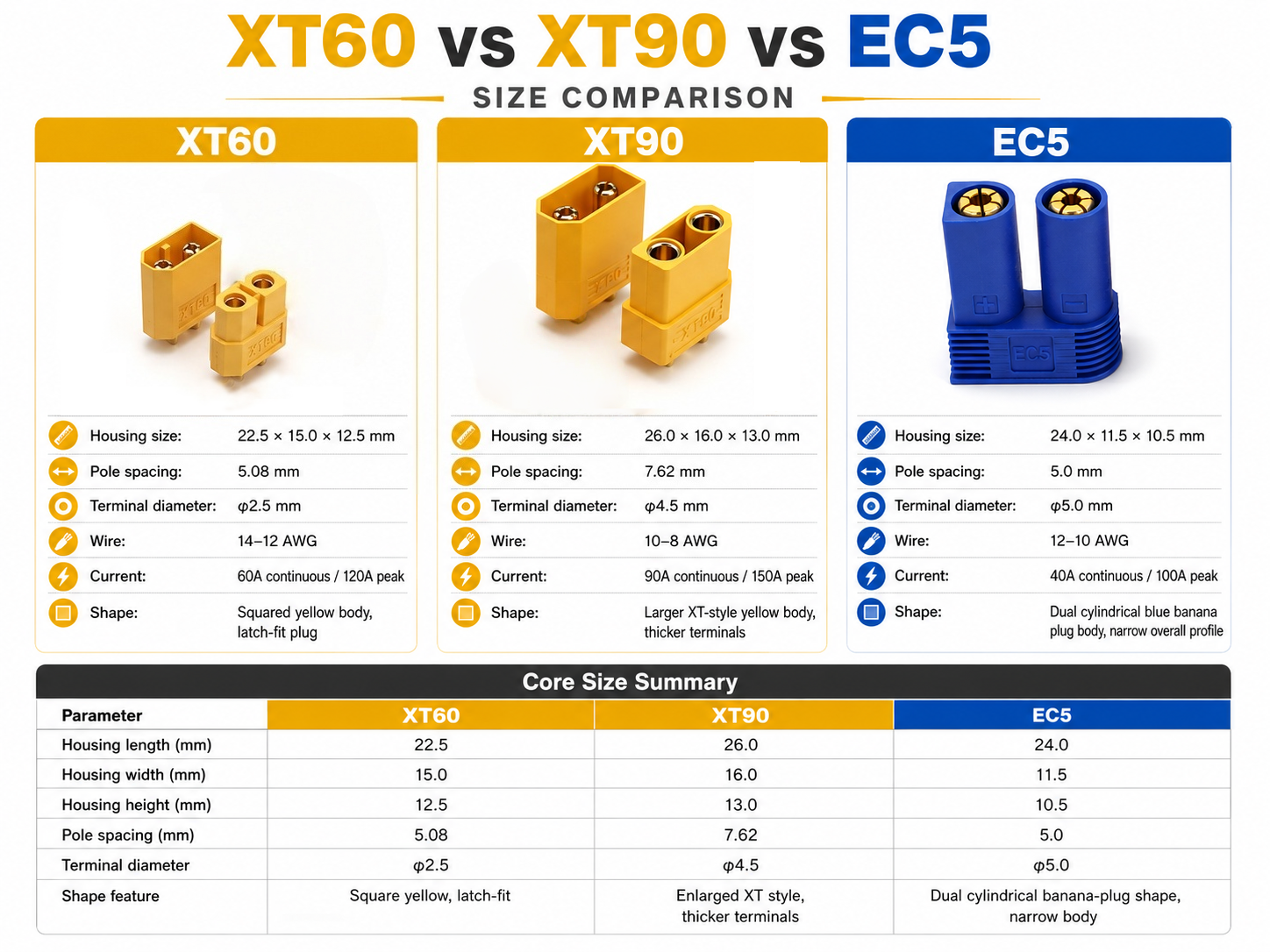
When looking at popular RC power connector alternatives, the EC series (such as the EC3 and EC5, along with Spektrum's modern IC3 and IC5 smart variants) represents the primary historical rival to the XT ecosystem. While both types serve high-current DC power needs effectively, they differ significantly in construction philosophy and user experience:
6. Industries & Applications
- Pin Integration vs. Two-Piece Design: XT connectors feature solid brass pins molded directly into a monolithic nylon housing body. In contrast, EC connectors use a two-piece design where separate gold-plated spring bullets (typically 3.5mm for EC3 and 5.0mm for EC5) are soldered to the wires first and then manually snapped or pushed into a plastic housing shell.
- Soldering and Assembly Difficulty: A common point of discussion in hobbyist forums is assembly ease. XT connectors are widely considered much easier to solder because the pins are rigidly fixed inside the housing (allowing you to pre-mate male and female halves during soldering to maintain alignment). EC connectors can be notoriously frustrating to assemble; if solder wicks up the outside of the bullet or if the wire flares too wide, pushing the soldered bullet into the plastic housing can require excessive force or result in a misaligned pin.
- Ecosystem Adoption: XT60 and XT90 dominate the global drone, FPV, multirotor, and general aircraft communities. Conversely, EC3/EC5 and IC3/IC5 connectors are heavily integrated into the Horizon Hobby / Spektrum ecosystem, making them very common in Ready-To-Fly (RTF) aircraft and surface RC cars.
- Physical Profile & Features: EC5 connectors offer a slightly slimmer, streamlined profile and use high-temperature fireproof plastics, whereas XT90 offers specialized factory variants like the XT90-S anti-spark option, which handles high-voltage in-rush currents natively without needing external spark arrestors. Furthermore, the newer IC-series (IC3/IC5) adds a central data wire for Smart battery telemetry, whereas traditional XT plugs require separate balance-lead telemetry wiring.
Before the introduction of the XT series, RC enthusiasts and electronics tinkerers relied heavily on standard Deans Ultra Plugs, Tamiya connectors, or loose gold-plated bullet connectors soldered together with heat shrink. While Deans plugs handled moderate current, they were notoriously difficult to grip with fingers (especially cold hands or greasy fingers in the field), prone to wearing out, and tricky to solder without melting the plastic housing.
While born out of the radio control hobby, the reliability and safety of XT connectors have driven their adoption across multiple modern technology sectors:
- Radio Control (RC) Hobbies: Electric helicopters, airplanes, cars, and surface vehicles using Lithium Polymer (LiPo) battery packs.
- FPV Drones & Multirotors: Tiny Whoops and micro builds use XT30; 5-inch freestyle and long-range cinematic drones universally rely on XT60.
- Micromobility & E-Bikes: Electric skateboards, scooters, e-bikes, and custom lithium-ion battery packs frequently deploy XT60 and XT90 connectors for main power output.
- Robotics & Maker Spaces: Combat robots, autonomous rovers, and Arduino/Raspberry Pi heavy-power distribution networks.
- Renewable Energy & Field Gear: Portable solar generators, field chargers, auxiliary power stations, and DIY 12V/24V power banks.
7. Standard Conventions, Safety, and Best Practices
- Polarity Convention: By global convention, the female housing is attached to the power supply side (the battery), while the male housing is attached to the consumer/load side (the ESC, drone, or charger). This prevents exposed live pins on a loose battery from accidentally shorting against metallic surfaces. On the flat side of the plug, small
+and-markings dictate polarity. - Soldering Tips: Always mate the male and female halves together *before* soldering thick wires to them. This locks the internal brass pins in correct alignment, preventing them from shifting or misaligning if the thermoplastic housing softens slightly from excessive soldering iron heat. Use a high-wattage, temperature-controlled iron to make fast, clean joints.
- Beware of Counterfeits: Because Amass XT connectors are heavily copied, low-quality knockoffs flood the market. Fake connectors often use inferior plastics that melt easily at low temperatures, use poorly plated brass that corrodes or oxidizes quickly, and feature loose tolerances that cause intermittent connections under vibration. Genuine Amass connectors feature sharp, crisp molding lines and a registered trademark next to the "XT" stamp.