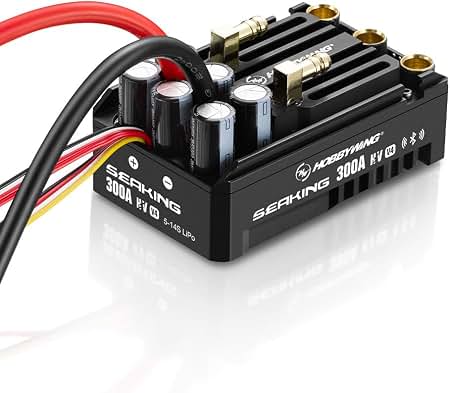
Hobbywing ESCs: Difference between "External Governor" vs "Fixed Wing" setting - Explained
Hobbywing ESCs feature flexible configuration profiles that dictate how the internal microcontroller handles throttle input signals, RPM feedback, and motor commutation timing. Two options that often create confusion during setup are "External Governor" (ExtGov) and "Fixed Wing" (Airplane) mode. While both pass throttle duty cycle commands directly through to the motor without active internal closed-loop RPM regulation, their internal signal conditioning, spool-up curves, and safety behaviors differ significantly.
1. Core Architectural Differences
To understand the difference, consider what an ESC does when governed internally versus externally:
| Parameter | Fixed Wing (Airplane) | External Governor (ExtGov) |
|---|---|---|
| Target Application | Fixed-wing airplanes, EDF jets, 3D aerobatic planes | Helicopters using Flybarless (FBL) system governors (e.g., Rotorflight, iKON2, VBar, BeastX) |
| Throttle Response Curve | Instantaneous, linear, 1:1 PWM mapping | Linear PWM mapping paired with a smooth soft-start ramp |
| Spool-Up Time | Immediate (0 to 100% in milliseconds) | Controlled soft spool-up (typically 8 to 15 seconds) |
| Bailout / Autorotation Ramp | Not Applicable | Fast response during autorotation recovery |
| RPM Output Signal (Yellow Wire) | Active (Raw RPM pulse) | Active (Raw RPM pulse fed to FBL sensor port) |
2. "Fixed Wing" Mode: Direct Linear Drive
In Fixed Wing mode, the ESC acts purely as an amplifier of the throttle signal coming from your receiver or flight controller:
- Zero Signal Conditioning: Every pulse-width variation on the throttle channel maps instantly to MOSFET gate switching frequencies. If you advance the stick from 0% to 100% in 10ms, the ESC attempts to drive 100% power to the motor immediately.
- No Soft Start: This instantaneous torque delivery is ideal for prop planes needing immediate thrust for hand launches, go-arounds, or 3D prop-hanging. However, applying this mode to a collective pitch helicopter will shred main gears instantly.
- No Governor PID Loops: The internal speed regulation routines are completely bypassed, lowering processing overhead and micro-latency.
3. "External Governor" Mode: Designed for FBL Control
In External Governor mode, the internal ESC governor PID loop is still disabled, delegating speed control to an external controller (such as a Rotorflight or iKON2 flybarless unit). However, the ESC retains critical safety algorithms tailored for helicopters:
- Soft Spool-Up Execution: When throttle is raised from 0% (TH Hold OFF), the ESC intercepts the command and executes a controlled, gradual ramp up to the commanded throttle level over several seconds. This prevents blade slap and gearing destruction while bringing the rotor head up to speed.
- Delegated Control Loop: Once the soft-start ramp completes, the ESC hands raw PWM control over to the flybarless governor. The FBL unit uses pre-computation (feed-forward pitch cues) and real-time RPM feedback from the ESC’s signal wire to hold head speed far more accurately than an ESC alone ever could.
- Bailout / Rapid Spool-Up Logic: If throttle drops to TH Hold and is subsequently flipped back ON within a set window (e.g., aborting an autorotation), the ESC bypasses the lengthy 10-second soft-start and ramps power back up in 1 to 2 seconds to recover the helicopter safely.
4. Summary Verdict
Use Fixed Wing mode exclusively for propeller-driven airframes where instantaneous stick-to-motor response is required. Use External Governor mode for helicopter builds where speed regulation is managed by your flybarless controller, giving you feed-forward RPM stability alongside built-in ESC soft-start protection.