Power Connector Showdown: XT60 vs. XT90 vs. EC5
When stepping up to mid-sized and large RC models—ranging from 500-class to 700-class helicopters, high-speed EDF jets, and custom e-bikes—choosing the right power connector is critical. Selecting a connector that is too small results in resistive heat buildup, voltage sag, and melted housings. Choosing one that is unnecessarily massive adds dead weight to your airframe.
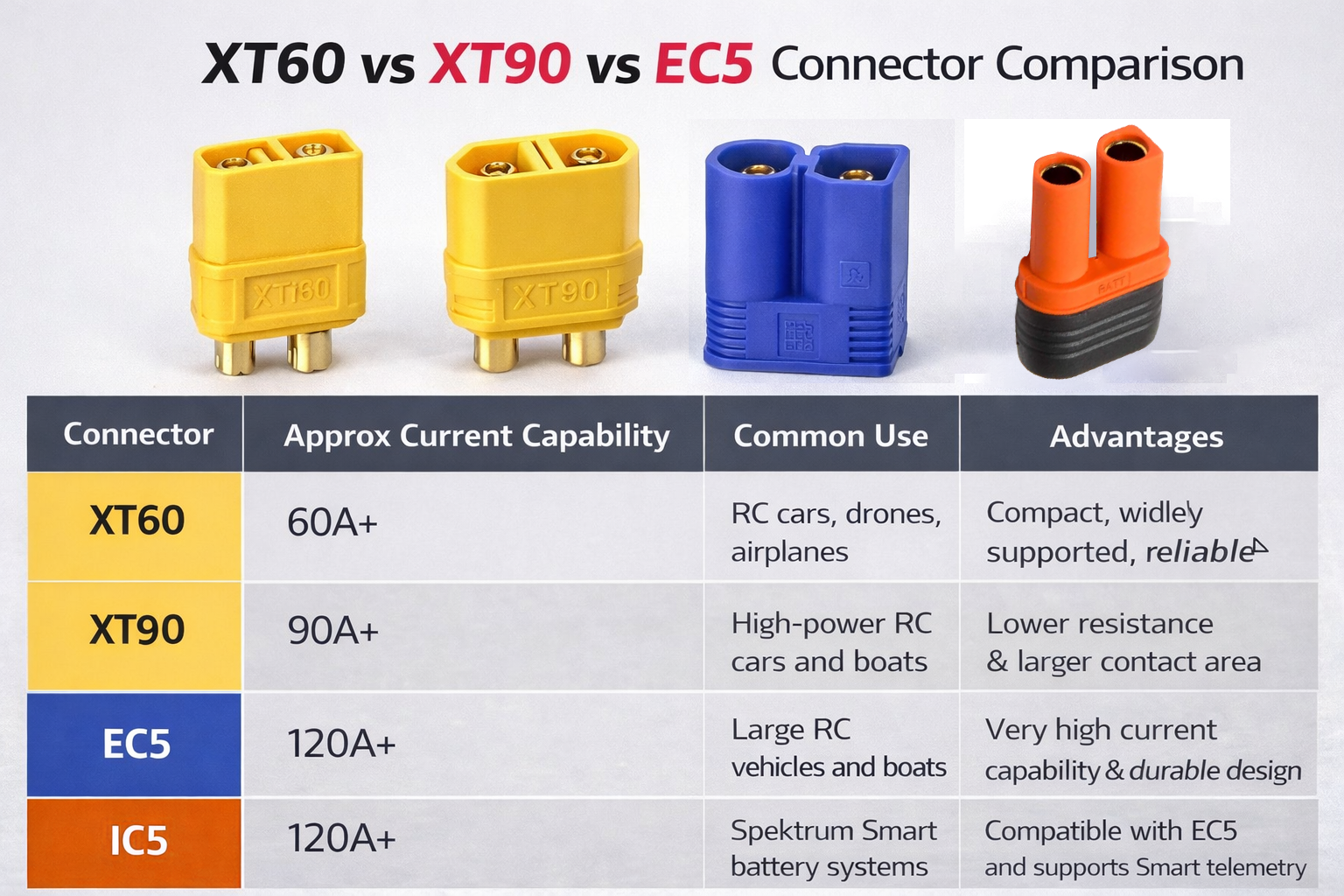
This article compares the three heavy-hitting power connectors in the hobby: the ubiquitous XT60, its heavy-duty sibling the XT90, and Horizon Hobby's popular high-current rival, the EC5.
1. Overview of Contenders
XT60
The gold standard for standard park flyers, 450/500-class helis, and 5-inch FPV drones. Rated for 30A continuous (60A peak), it utilizes 3.5mm gold-plated bullet pins molded into a rugged, polarized nylon housing. It is lightweight (~9.5g per pair) and easy to grip.
XT90
The heavy-duty workhorse designed for larger power systems (6S to 12S setups). Featuring 4.5mm pins, it handles 40A continuous (90A+ peak / 150A+ burst). Available in standard and anti-spark (XT90-S) variants, it is built to manage massive amperage without breaking a sweat.
EC5
The primary historical and ecosystem competitor to the XT series (popularized across Horizon Hobby, Spektrum, and high-power surface/air models). The EC5 uses two separate 5.0mm gold-plated bullet contacts that snap into a streamlined, high-temperature plastic housing shell. It handles 120A+ continuous current with ease.
2. Direct Comparison Table
| Specification | XT60 | XT90 | EC5 |
|---|---|---|---|
| Continuous Current Rating | 30A Continuous (60A Peak) | 40A Continuous (90A+ Peak / 150A+ Burst) | 120A Continuous (150A+ Peak) |
| Pin / Contact Diameter | 3.5 mm | 4.5 mm | 5.0 mm |
| Recommended Wire Gauge | 10–12 AWG | 8–10 AWG | 10–12 AWG |
| Construction Design | Monolithic molded nylon housing with integrated fixed pins | Monolithic molded nylon housing with integrated fixed pins | Two-piece design: separate spring bullets inserted into a snap-fit housing shell |
| Anti-Spark Feature | Not required at 3S–4S voltages | Available via specialized tip resistor variant (XT90-S) | Requires external spark arrestor or IC5 Smart variant for high voltage |
| Weight (Pair) | ~9.5 g | ~18 g (Standard) / ~22 g (Anti-Spark) | ~12–14 g |
3. Key Engineering & Usability Differences
Assembly & Soldering Experience
- XT Series (XT60 & XT90): Widely considered easier to solder because the brass pins are rigidly anchored inside the molded plastic body. You can mate the male and female halves together *before* soldering thick wires to prevent the pins from shifting if the plastic softens slightly under heat.
- EC5: Uses a two-piece design where you must solder wires to loose 5.0mm bullets first, then push them into the plastic housing. If solder wicks down the outside of the bullet or if the wire flares too wide, inserting the bullet into the housing can require excessive force or result in a misaligned pin.
Current-Carrying Capacity & Voltage Sag
- XT60: Perfect for systems drawing under 30A continuous. Pushing an XT60 into 700-class nitro-conversion or heavy 6S/12S electric territory will cause severe resistive heating and voltage sag.
- XT90 & EC5: Both are built for heavy-draw applications (60A to 120A+). The EC5's larger 5.0mm bullets provide an exceptionally low-resistance pathway for high-amp surges, matching or exceeding the raw current capacity of the standard XT90.
Anti-Spark Capabilities
- High-voltage setups (6S to 12S LiPos operating above 22V) experience a massive in-rush current spark when plugged in, pitting gold pins and wearing down ESC capacitors.
- The XT90-S solves this natively with a built-in pre-charge resistor tip. To achieve the same spark-free connection with an **EC5**, pilots typically have to rely on external spark arrestors or upgrade to Spektrum's **IC5** ecosystem.
4. Summary Recommendation
- Use an XT60 for micro/mini builds, FPV drones, and smaller power systems under 30A.
- Use an XT90 (or XT90-S) when building 6S to 12S systems where native anti-spark protection and rigid molded housings are top priorities.
- Use an EC5 if you are embedded in the Horizon Hobby/Spektrum ecosystem or prefer a streamlined, high-current 5.0mm bullet design that handles 120A+ continuous loads effortlessly.