
Blackbox Log Analysis: Roll Axis Behavior
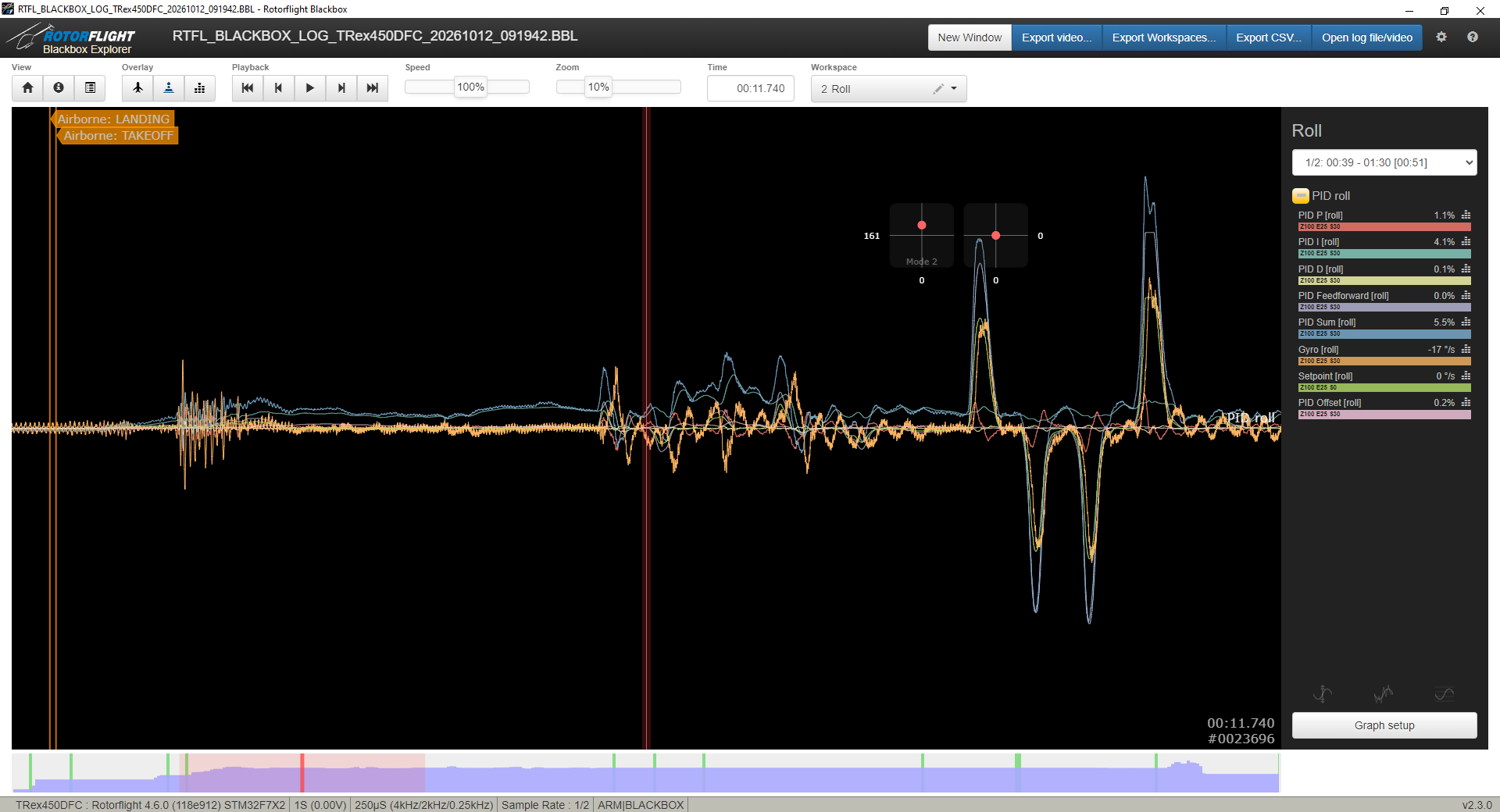
Here is an actual sample (see pic inset) where we provided a Blackbox capture of some obvious problems seen the Roll axis, here is a breakdown of what is immediately evident, the underlying causes, and actionable steps to resolve them.
1. What is Obvious & Evident in the Log
- Severe Stick-Stop Overshoot: Look at the sharp command peaks on the right side of the graph. When a fast roll command is abruptly stopped, the yellow PID sum and light blue setpoint trace spike dramatically past the zero line, followed by a noticeable bounce back.
- Asymmetrical Response: The positive roll inputs (peaks extending upward) and negative roll inputs (troughs extending downward) show uneven recovery behavior and differing amounts of overshoot amplitude.
- D-Term & Feed-Forward Lag: The damping reaction is currently struggling to catch the momentum of the rapid cyclic stop, resulting in that wide oscillation wave right after stick release.
2. What to Do to Fix It
- Increase D-Term Gain / Check Cutoff: Raise your Roll Derivative (D) gain slightly or verify your D-term filtering to ensure the controller has enough hydraulic-like resistance to halt the roll instantly without bouncing.
- Fine-Tune Feed-Forward (FF): Since your FF was recently adjusted down to 100, a slight rebound or under-prediction during rapid direction reversals can occur. Nudge Roll FF up by 3 to 5 points (to 105) to sharpen the stop.
- Examine Integrator Saturation: Ensure your Roll Error Limits aren't clipping too aggressively during high-rate rolls, which can cause the momentary trace blowouts visible in the center of the graph.
Section 3: Addendum — What Happens When You Make These Adjustments?
To understand how your helicopter will react on the bench and in the air, here is a detailed breakdown of the precise mechanical and algorithmic consequences of making a minor bump in Roll Feed-Forward (FF) versus a slight increase in D-term gain.
1. The Result of a Minor Bump in Roll Feed-Forward (FF)
Feed-Forward bypasses the error loop to provide instant predictive stick response based entirely on your stick input.
- What Happens: The initial initiation of a roll becomes sharper, and the aircraft snaps into rotation the exact millisecond you move the stick.
- The Risk / Trade-off: If bumped too high, the aircraft will over-rotate or "overshoot" your stopping point, forcing you to fight the sticks to correct the bounce back. A minor bump (e.g., +3 to +5) tightens the connection without causing over-shuttle.
2. The Result of a Slight Increase in D-Term Gain
The Derivative term calculates the rate of change of error, acting as a digital electronic shock absorber that resists sudden velocity changes.
- What Happens: When you stop a rapid roll or flip, an increased D-term applies immediate braking force to halt the rotational momentum cleanly, flattening out the spikes and eliminating the tail-end bounce seen in the Blackbox log.
- The Risk / Trade-off: If pushed too far, the servos will work frantically against high-frequency mechanical noise, leading to servo heating, a harsh or "crunchy" feeling in the sticks, and potential oscillation. A slight increase keeps the damping clean without triggering servo strain.
Combined Summary: Adjusting these two parameters in tandem allows you to carve out that sharp, locked-in trajectory where the helicopter starts instantly on command and stops like it hit an invisible wall—mirroring the precise behavior you love on your iKON2 setups!