
Mastering Boost (B-Term) Tuning for RC Helicopters
In Rotorflight, the Boost parameter (often referred to as B-gain or B-term) is a powerful tool for pilots looking to increase the "snap" and responsiveness of their helicopter beyond what standard P-gain can achieve. While P-gain provides the muscle to get to your target, Boost provides a rapid, short-term increase in command intensity.
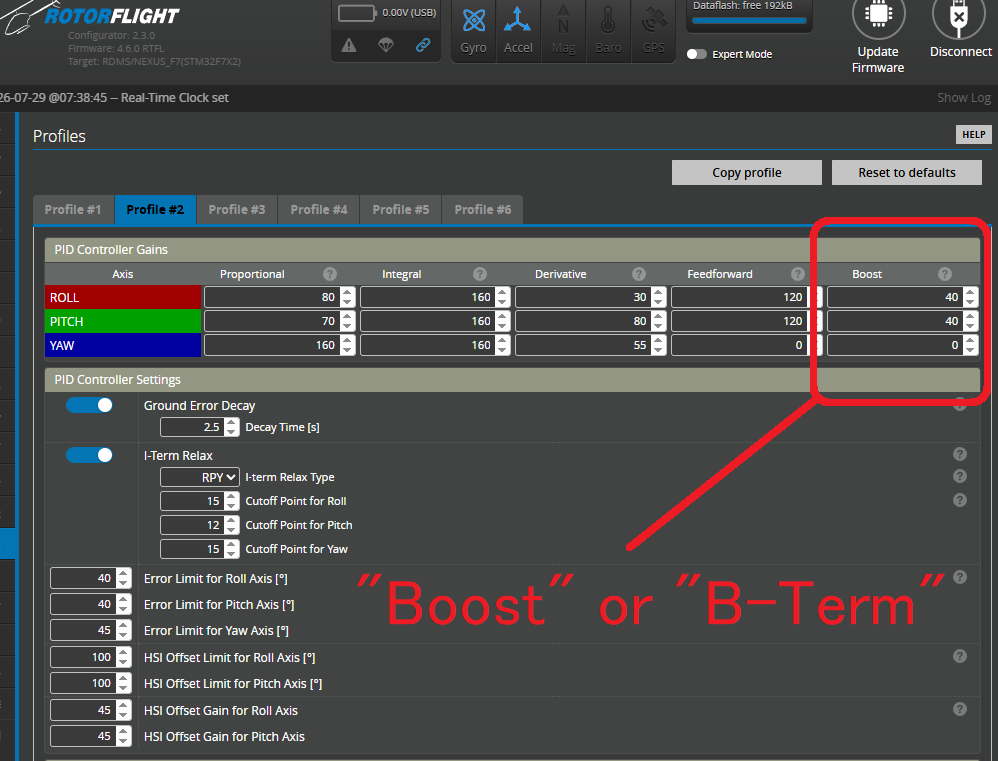
What is Boost (B-Term)?
Boost is a setpoint accelerator. When you move your sticks, Boost momentarily amplifies your command to force the helicopter to react faster. It is specifically useful when the aircraft feels "lazy" or sluggish during initial stick inputs, even if your P-gains are already optimized.
Key Concepts: Gain and Cutoff
Boost is not just a single value; it works in conjunction with two parameters:
- B-Gain: The intensity of the "boost." Typical values range from 20 to 50.
- B-Cutoff: This defines the time window for the boost effect. It ensures the acceleration is a "short-term" injection rather than a permanent change to the control signal.
Tuning Methodology
Because Boost is an advanced "fine-tuning" parameter, it should be adjusted only after your P, I, D, and Feed-Forward gains are already stable.
- Incremental Increases: Start low and increase in small steps. It is often recommended that only the Pitch axis requires significant Boost.
- Test Response: Perform quick, sharp stick inputs to feel the difference in initial acceleration.
- Monitor for Overshoot: If you add too much Boost, you will notice the helicopter "kicking" or oscillating at the start of a maneuver, or struggling to settle at the end of a rapid stop.
Symptoms of Incorrect Settings
| Status | Symptoms / Behaviors |
|---|---|
| Too Little Boost | The helicopter feels "lazy" or slow to initiate sudden maneuvers. It lacks the "pop" or "snap" you might expect during aggressive stick inputs. |
| Too Much Boost | The heli feels twitchy or spastic. You may observe "unwanted oscillations" at the beginning or end of stops, as the flight controller is over-reacting to your initial input. |
Recommended Maneuvers for Testing
To flesh out whether your Boost setting is dialed in, focus on maneuvers that require instantaneous reaction:
- 4-point Rolls/Flips: Perform the maneuver observing how fast the craft stops and starts at all four points. Increase if it feels, "lazy" or if you're looking for a more, "crisp" feel.
- Rapid Pitch Pumps: Check how quickly the nose reacts to a full-collective punch. If it feels "mushy" initially, you may need more Boost.
- Tick-Tocks: These are excellent for testing the overall "snap" of the pitch axis. If the heli doesn't feel crisp during the reversal, Boost can help tighten the transition.
- Quick Directional Jabs: Use short, sharp flicks of the sticks to evaluate how immediate the response is compared to your baseline.
Pro-Tip: Remember that Boost is axis-specific. If your Roll is already feeling crisp, leave it alone. The Pitch axis is notoriously more difficult to tune and is usually the primary candidate for Boost adjustments.
A video tuning example
In this video, Ben Britton notices a deficiency in a flight characteristic of his model that he uses the B-Term to adjust. The video has been time indexed to the correct time when Ben discusses Boost - Just press "Play".
Note: You may later decide to "rewind" the video before our start point in order to see the maneuvers he uses (4-point roll) to discover the deficiency in the flip