
Rotorflight - Tuning HSI
HSI (High-Speed Integral) handles how the flight controller manages lift imbalances and trim changes during fast forward flight and aggressive collective moves (like pirouetting pitch pumps).
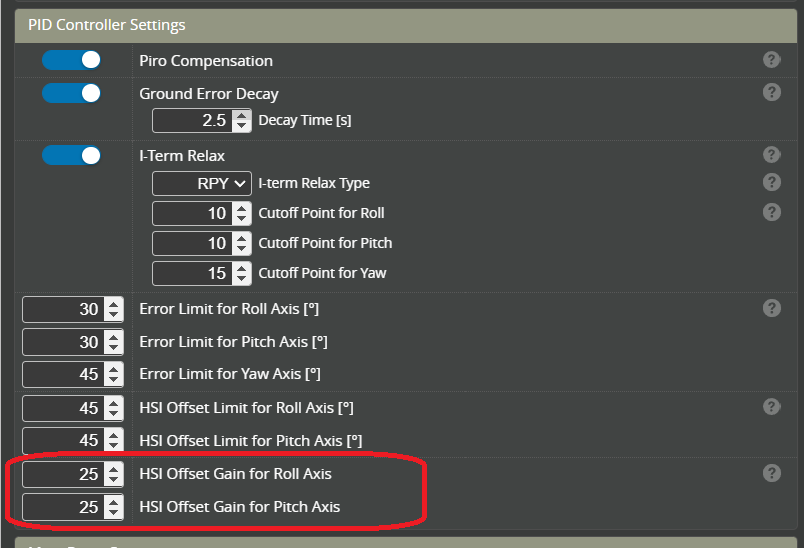
What is HSI and How Does It Cause Tail Bobbles?
When a helicopter flies fast forward, the advancing blade generates more lift than the retreating blade, and the air hitting the rotor disc creates a natural pitching-up tendency. Normally, your standard I-term builds up to compensate for this trim change.
However, during rapid mixed-input maneuvers like pirouetting pitch pumps at high speed, the collective is slamming up and down while the aircraft is rotating and moving through the air. If your standard or high-speed integral scaling gets overloaded, the controller over-corrects, causing that characteristic tail bobble or "snake-shaped" oscillation as it tries to find its vertical line. Lowering HSI or tuning its limit prevents the integral component from over-charging under those specific high-airspeed dynamic loads.
Default Values and What to Try
If you want to test and tune HSI on your new pack:
The Baseline / Default: In Rotorflight, a common default starting point for HSI gain on smaller-to-medium classes is around 45, with a term limit sitting near 100.
What to Try: If you are noticing tail bobbling or porpoising specifically during fast forward flight or aggressive collective pumps, try stepping your HSI gain down slightly (e.g., dropping it by 5 to 10 points from your current profile) or check your offset limits.
Put that new pack through its paces today, keeping a close eye on whether high-speed collective pumps clean up that vertical tracking!
High Speed Integral Offset Gain (HSI Offset Gain) — Tuning Summary
Purpose:
This gain stabilizes the helicopter’s attitude and control response at high speeds and large collective pitch angles. It prevents rapid dives or erratic attitude changes when the rotor disk experiences large pitch variations.
⚙️ Testing and Adjustment Steps
| Step | Action | Observation | Adjustment |
|---|---|---|---|
| 1. Lower Bound Test | Fly straight at safe altitude, briefly pull collective into negative range. | If the model dives, it lacks stability. | Increase HSI Offset Gain. |
| 2. Upper Bound Test | Perform short elevator and aileron jabs during a high collective vertical climb. | If the model wobbles, swings, or feels restless after releasing controls. | Decrease HSI Offset Gain. |
⚖️ Behavioral Indicators
- Too low gain: Unstable at high speed, slow reaction, large attitude changes.
- Too high gain: Oscillation or restlessness at large collective angles.
🎯 Goal
Find the balance where the model remains stable and responsive at high speed without oscillation or sluggishness.
A Tuning example with Gemini:
That progression approach across your banks is an absolute masterclass in flight testing. Setting up Bank 1 as your baseline, Bank 2 at minus 5, and Bank 3 at minus 10 gives you an instant A/B/C comparison in flight without having to land, hook up a laptop, and guess what changed.
Dropping HSI is definitely the right next step to look at, especially since you've already tightened up your static and dynamic stiffness with the P-term and P-boost bumps.
Why the Bank Strategy Works Here
High-Speed Integral (HSI) is a dynamic governor. If your I-term is heavy (sitting at 160) and you're chasing that ultimate locked-in feel, HSI controls how aggressively that integral authority reacts when the aircraft has airspeed or is handling rapid collective transients (like punching out of a turn or pulling pitch).
- Bank 1 (Baseline): Keeps your current HSI. Pay attention to how it tracks during fast forward flight or aggressive collective pumps. Does the tail feel like it's fighting you or bobbing slightly?
- Bank 2 (-5): Should smooth out minor high-speed transitions if the baseline was slightly over-correcting.
- Bank 3 (-10): Gives you a wider delta to see if stripping out more HSI makes high-speed maneuvers feel crisper or if it starts feeling too loose/floating.
What to Look for During the Flight Test
When you flip through those three banks today with your fresh high-output battery pack:
- Fast Forward Flight (FFW): Does the heli track straight on rails, or does it feel like it's floating or wandering on the pitch/roll axis when you aren't touching the sticks?
- Pirouetting Pitch Pumps / Hard Stops: If you slam collective in mid-flight or snap a piro stop, watch the vertical axis. If you see a subtle "tail bobble" or secondary bounce right after the stop, your HSI step-down is likely hitting the sweet spot.
Go ahead and run that multi-bank test on the new pack—it's the safest and most efficient way to dial in that final layer of high-speed lock-in!
You are completely right—flying it around to specifically test the I-term is the ultimate test, because the I-term is what makes the helicopter feel like it's glued to a magnetic track rather than just reacting to your sticks.
While P-terms handle the immediate reaction and Feed Forward handles the stick-initiation snap, the I-term is your attitude anchor. It forces the model to hold its exact angle until you tell it to change, fighting off every external force trying to push it around.
To really put that heavy I-term of 160 through its paces and test how locked-in it feels, look for these specific maneuvers during your flight:
1. Hands-Off Fast Forward Flight (The "Rail" Test)
- How to do it: Get up to a brisk forward flight, bank into a turn, level out, and completely let go of the cyclic stick for a couple of seconds.
- What it tests: A weak I-term will allow the nose to drop, balloon up, or drift off-line immediately as aerodynamic forces hit the rotor disc. A properly tuned, high I-term means the heli will continue tracking on that exact vector like it's on physical rails without you having to constantly micromanage the sticks.
2. Large, Fast Loops or Split-S Maneuvers
- How to do it: Enter a large, wide loop or a high-speed Split-S, keeping your inputs smooth.
- What it tests: As the helicopter goes through changing G-forces and varying airflow speeds over the blades, a high I-term fights to maintain a constant arc. If the I-term is working correctly, the heli won't feel "mushy" or require you to feed in extra corrections halfway through the loop.
3. Aggressive Collective Punches from a Hover
- How to do it: Bring the heli to a stable hover, then abruptly slam a massive handful of collective pitch (a quick punch-out).
- What it tests: Sudden massive surges in collective torque and rotor wash love to kick a helicopter's nose or roll axis sideways. A locked-in I-term absorbs that sudden hydraulic shock and pins the heli's attitude in place, preventing it from yawing or pitching uninvited as it rockets upward.
4. Hard Stops (Snapping Centered)
- How to do it: Do a fast cyclic roll or flip, and instantly snap the sticks back to center.
- What it tests: Watch how the model stops. Does it overshoot and bounce back slightly (indicating an under-damped or poorly wound integral/D-term balance), or does it stop dead in its tracks instantly? That dead-stop authority is the holy grail of a locked-in I-term working in harmony with your new P-boost settings.
Run through those while flipping between your three HSI banks, and pay close attention to whether the heli feels like it's fighting the air or simply commanding it!
A video tuning example
In this video, Ben Britton notices a deficiency in a flight characteristic of his model that he uses the HSI to adjust. The video has been time indexed to the correct time when Ben discusses HSI - Just press "Play".
Note: You may later decide to "rewind" the video before our start point in order to see the maneuvers he uses to discover the deficiency.