
The Evolution of Spektrum Air Transmitters: From Silver DX7 to Modern NX+ and iX+ Systems
Since pioneering mainstream 2.4GHz spread-spectrum flight control in the mid-2000s, Spektrum has reshaped how radio-controlled pilots connect to fixed-wing aircraft, helicopters, and multirotors. Over two decades, the lineup has evolved from monochrome silver boxes running basic DSM/DSM2 protocols to full-color embedded NX+ systems and Android-driven iX+ workstations featuring Smart Telemetry, Forward Programming, and contactless Hall-effect gimbals.
This technical dossier traces every major Spektrum transmitter generation, highlighting the hardware fixes, RF protocol upgrades, and software additions introduced—or retired—along the way.
& Architectural Milestones
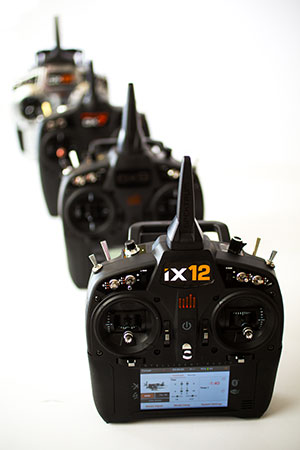
To understand the differences between Spektrum's transmitter families, it helps to examine the three core engineering transitions that define their hardware:
- DSM → DSM2 → DSMX Protocol Evolution: Early 2005–2006 radios launched on original DSM (park-flyer range) and DSM2, which locked onto two static 2.4GHz channels at power-on. In late 2010, Spektrum introduced DSMX, combining wideband DSSS modulation with active frequency-hopping across the 2.4GHz band to eliminate multi-pilot interference at crowded events.
- G1 Single-Processor vs. G2+ Embedded AirWare: Early DX transmitters (DX6i, DX7, DX8 G1) lacked onboard voice alerts, wireless trainer links, and internal SD file sharing. The "Black" DX Gen 2 platform introduced dual-processor architecture, spoken voice alerts, antenna diversity, and Forward Programming—eventually hitting a hardware memory ceiling that prompted the launch of the modern NX platform.
- Model File Compatibility (.SPM vs. .NSPM vs. .iSPM): DX Gen 2 radios read and write
.SPMfiles. Modern NX transmitters read both legacy.SPMand native.NSPMformats (allowing easy upgrades from DX radios), while Android-based iX transmitters use.iSPMand act as universal translators capable of importing both DX and NX model files.
Official technical specifications, AirWare update changelogs, and Smart Transmitter File (STF) downloads.
Master Matrix
The reference matrix below summarizes every major Spektrum air transmitter generation, comparing channel counts, RF protocols, user interfaces, gimbal hardware, and hallmark features added or retired in each series.
| Series / Era | Key Models & Variants | Channels | RF Protocol | Display & OS | Key Enhancements, Fixes & Removals |
|---|---|---|---|---|---|
| Early Silver Era (2005–2010) |
DX6 (G1), DX7 (Silver), DX7SE, DX6i, DX5e | 5 to 7 | DSM / DSM2 (Late DX6i: DSMX) |
Monochrome Segment LCD; Basic Embedded | Added: Mainstream 2.4GHz spread spectrum, ModelMatch, 11ms high-speed frame rate on DX7SE. Limitations: Fixed frequency pair (DSM2), no telemetry, no voice, no SD card slot. |
| DX Gen 1 Transition (2010–2013) |
DX8 (G1 Silver/Black), DX7s, DX10t, DX18 (G1) | 7 to 18 | DSM2 & DSMX | Backlit Monochrome Dot-Matrix LCD; AirWare G1 | Added: Frequency-hopping DSMX, built-in real-time telemetry, vibration alerts, SD card model storage. Limitations: Single antenna on early units; no spoken voice alerts on DX7s/DX8 G1. |
| DX "Black" Gen 2 & Gen 3 (2013–2021) |
DX6 (G2/G3), DX7 (G2), DX8 (G2), DX9, DX18 (G2/QQ), DX20 | 6 to 20 | DSMX (DSM2 removed on EU/later units) |
Backlit Monochrome LCD; AirWare G2 | Added: Dual-antenna diversity (handle + front), programmable voice alerts, wireless trainer, Forward Programming. Removed: DSM2 support on newer revisions; phased out after hitting hardware RAM/ROM ceiling. |
| Entry & RTF Budget Line (2016–Present) |
DXe, DXS, DX6e, DX8e | 6 to 8 | DSMX (DSM2 on early e-models) | None (DXe/DXS) or Monochrome LCD (DX6e/8e) | Added: Affordable entry points; DXS added LED battery/telemetry bar. Removed: Voice alerts, wireless trainer instructor (DX6e/8e), internal SD storage, and serial port power. |
| NX & NX+ Embedded Series (2020–Present) |
NX6, NX7e / NX7e+, NX8 / NX8+, NX10 / NX10+ / SE, NX20 | 6 to 20 | DSMX (DSM2 compatible on US models) | 2.8" to 5.0" Color TFT Screen; Next-Gen AirWare | Added: Color display, built-in Wi-Fi firmware updates, native Smart Telemetry, Smart Transmitter Files (STF), USB-C/Li-Ion battery, folding antenna, 20-channel expansion on "+" models, Hall gimbals on NX10/10+/20. |
| iX & iX+ Smart Series (2017–Present) |
iX12, iX14, iX14+ / SE, iX20, iX20SE | 12 to 20 | DSMX (DSM2 compatible on US models) | 4.0" to 5.0" Full Color Touchscreen; Android OS + AirWare App | Added: Android touchscreen UI, custom text-to-speech voice synthesis, Bluetooth audio/file sharing, Hall-effect quad-bearing gimbals, touch-sensing switches, 250-model memory, faster boot processors on "+" models. |
Deep Dive
-
The Silver Pioneers (DX6 G1, DX7 Silver, DX7SE, DX6i):
Spektrum's first-generation silver transmitters eliminated the need for frequency pins at flying fields. The iconic silver DX7 (co-developed with JR hardware ergonomics) became the standard for 450-to-600 class helicopters, while the DX7SE removed trainer ports to achieve an ultra-fast 11ms frame rate for 3D helicopter pilots. However, early DSM2 radios locked onto just two frequencies at startup, making them vulnerable to signal masking if interference occurred mid-flight—a limitation permanently solved by DSMX.
-
The Transition Era (DX8 G1, DX7s, DX18 G1):
Released in 2010, the original silver-accented DX8 was Spektrum's first in-house platform featuring native DSMX frequency agility, integrated telemetry screens, and an SD card slot for model backups. While revolutionary, early DX8 G1 units lacked spoken voice alerts (relying only on beeps and stick vibration) and utilized a single external antenna.
-
The DX "Black" Gen 2 & Gen 3 Workhorses (DX6 G2/G3, DX8 G2, DX9, DX18 G2, DX20):
The matte-black DX Gen 2 series fixed nearly every ergonomic and RF complaint of the first generation. Spektrum added a second diversity antenna inside the top carry handle, full spoken voice alerts, wireless buddy-box training, and Forward Programming (allowing pilots to configure AS3X and SAFE receivers directly from the transmitter screen). The DX9 and flagship DX18/DX20 set the benchmark for build quality, though the underlying processor eventually ran out of RAM/ROM to support newer Smart ecosystem protocols.
-
The "e" & "S" Budget Variants (DXe, DXS, DX6e, DX8e):
Designed to keep Ready-To-Fly (RTF) and Bind-N-Fly (BNF) packages accessible, the "e" (economy) variants stripped away premium hardware while preserving core DSMX link reliability. The DX6e and DX8e retained the black chassis and AirWare menus but removed spoken voice alerts, antenna diversity, and rechargeable Li-Ion packs (reverting to 4x AA batteries). The screenless DXS replaced the older DXe, adding simple LED telemetry voltage indicators for beginner trainers.
-
The NX & NX+ Embedded Revolution (NX6, NX7e+, NX8+, NX10+, NX20):
Introduced to replace the aging DX line, the NX series kept Spektrum's fast, instant-on embedded operating system and physical roller wheel while upgrading the hardware to a backlit color LCD screen, built-in Wi-Fi for direct firmware updates, USB-C charging, a folding antenna, and out-of-the-box Smart Telemetry. With the subsequent "+" firmware and hardware refresh (NX7e+, NX8+, NX10+), Spektrum unlocked up to 14 to 20 channels across mid-range models and introduced Smart Transmitter Files (STF), allowing compatible receivers to automatically load model setups upon binding. Notably, the NX10, NX10+, and NX20 feature contactless Hall-effect gimbals.
-
The iX & iX+ Android Flagships (iX12, iX14+, iX20 / SE):
Built for turbine jets, giant-scale aerobatics, and competition 3D helicopters, the iX series pairs Spektrum's RF deck with a full Android touchscreen interface. Unlike the NX series' pre-recorded voice library, the iX uses custom text-to-speech synthesis to announce any custom telemetry metric, supports Bluetooth earbuds, offers capacitive touch-sensing switches (activating timers or voice readouts simply by resting a finger on a switch), and uses precision quad-bearing Hall-effect gimbals. The updated iX14+ and iX20SE feature upgraded processors that dramatically cut Android boot times.
Which Spektrum Series Fits Your Flying Level?
Because every modern Spektrum transmitter shares the exact same core DSMX RF protocol and core AirWare programming logic, choosing the right model comes down to channel requirements, gimbal precision, and user interface preference:
-
Beginners & Park Flyers (DXS or NX7e+):
If you are learning on a SAFE-equipped trainer, the bundled DXS gets you in the air immediately. However, stepping up to the NX7e+ gives you 14 channels, a color screen, and Smart model templates that will grow with you for years.
-
Intermediate Sport & BNF Pilots (NX8+):
The NX8+ hits the sweet spot for intermediate pilots flying warbirds with retracts, flaps, and gyro stabilization—delivering 20-channel capability, voice alerts, and Wi-Fi updates without paying flagship prices.
-
Serious 3D Heli & Aerobatic Pilots (NX10+):
For pilots demanding instant-on boot times alongside silky-smooth, zero-wear Hall-effect gimbals and a 6600mAh Li-Ion battery, the NX10+ is the premier traditional roller-wheel transmitter in Spektrum's lineup.
-
Giant-Scale, Turbine & Tech Enthusiasts (iX14+ or iX20SE):
If you manage complex multi-engine mixes, sequencer doors, extensive Smart telemetry voice callouts, and prefer smartphone-style touchscreen editing at the flight line, the iX14+ or iX20SE provides unmatched customization.