
Mastering RC Helicopter Flight in the Wind: A Dual-Track Simulator and IRL Training Program
With the advent of advanced non-GPS stabilization systems and self-leveling firmware—popularized by trainers like the Horizon Hobby Blade 230 S and newer entries like the Blade 230 CP Pro—learning to hover and cruise has become much more accessible for newcomers. However, transitioning from calm-day hovering into breezy outdoor conditions introduces external aerodynamic forces that can quickly overwhelm pilots. This guide outlines two specialized training plans utilizing a blend of simulator practice and In Real Life (IRL) field sessions to build wind-management competence for both stabilized ("SAFE" mode) users and pilots flying in raw, non-stabilized modes.
Transitioning Stabilized (SAFE) Pilots to Wind
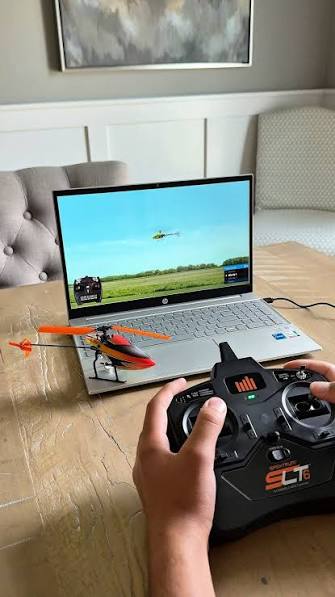
Pilots who rely on self-leveling modes benefit from built-in banking limits and auto-recovery features, but wind gusts can still push a micro or sub-micro helicopter off station unexpectedly. Because the flight controller fights drift for you, pilots often fail to develop proactive cyclic compensation. This progressive blueprint bridges that gap using simulator environment adjustments paired with field execution.
Begin your training on software platforms like RealFlight or Heli-X by setting crosswind velocity to a mild 3 to 5 mph. Focus entirely on maintaining a fixed tail-in hover box while the system manages self-leveling. Once comfortable, increment wind speeds by 2 mph steps until reaching your target threshold, paying close attention to how collective pitch must be managed dynamically during gusts.
Track 1 Execution Blueprint
-
Simulated Wind Hovering:
Configure your simulator with a steady 5 mph crosswind. Practice holding a tight 6-foot box in SAFE/Stability mode, noticing how the nose weather-vanes into the wind and counteracting it smoothly with tail rudder inputs.
-
IRL Light Breeze Hovering:
Take your stabilized machine (such as a Blade 230-class heli) out on a day with 3–5 mph gusts. Keep the helicopter close in tail-in orientation. Focus on small, deliberate cyclic corrections rather than erratic gross movements.
-
Simulated Translational Lift & Drift:
In the simulator, advance to slow side-to-side lateral slides across the wind axis. Learn how wind resistance increases drag when moving into a headwind versus tailwind, requiring variable collective and cyclic pressure.
-
IRL Side-to-Side Translation:
Execute gentle left-and-right side translations outdoors in light wind. Keep translations short (10 feet wide) so that if a gust catches the rotor disc, you can easily click back to center or let self-leveling arrest momentum.
-
Simulated Circuits & Figure-8s in Wind:
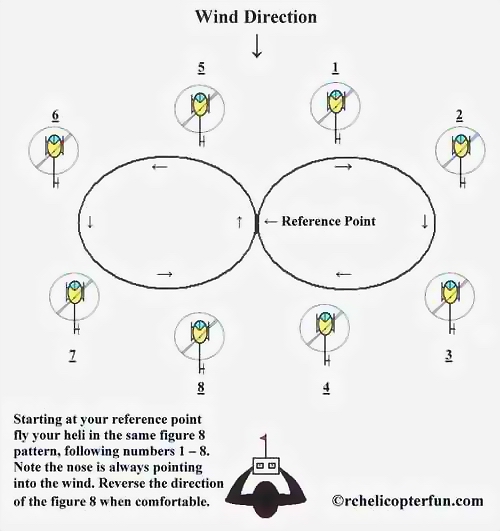
Program moderate, gusty wind profiles in your sim. Fly large, sweeping oval circuits. Observe how the model loses or gains altitude when turning downwind due to ground speed differentials relative to true air speed.
Non-Stabilized Pilots Advancing to Outdoor Breezes
Pilots flying without self-leveling assistance (pure rate/attitude mode on Flybarless systems or Rotorflight setups) experience true aerodynamic drift. Without computer auto-correction, every gust requires immediate, proportional stick deflection followed by an instantaneous counter-correction to prevent over-control. Mastering wind in this mode transforms you from a passenger into an active pilot.
Your simulator sessions should remove all artificial stabilization assistance and feature turbulent, variable wind profiles with micro-gusts. Practice holding dead-center hovers while turbulence attempts to roll or pitch the model unexpectedly. Muscle memory must override panic when the model gets pushed around.
Track 2 Execution Blueprint
-
Simulated Turbulence & Hover Discipline:
Fly in the simulator with "thermal turbulence" and variable gusts turned on. Force yourself to keep a non-stabilized 700-class or 500-class model completely stationary within a 3-foot virtual box.
-
IRL Fighting the Wind in a Hover:
Fly your un-stabilized machine outdoors in 10-15 mph winds. Start with tail-in, progress to side-in (left and right), and finally nose-in hover. Anticipate gusts by leaning the rotor disc aggressively *into* the oncoming wind source.
-
Simulated Side-to-Side & Up-and-Down Drills:
Practice vertical climbs and descents in heavy sim wind. Crosswinds love to push tail booms sideways during vertical column maneuvers; learn to mix precise rudder and aileron corrections seamlessly.
-
IRL Vertical Column & Lateral Maneuvers:
Perform slow vertical ascents and descents outdoors, maintaining a straight plumb-line against a background tree or pole. Follow this with crisp, unyielding side-to-side box patterns.
-
Full-Scale Circuits and Figure-8s:
Integrate everything into continuous figure-8s across a heavy crosswind line. Manage banking angles tightly: steeper bank into the wind on upwind legs, shallower drift-compensating arcs on downwind legs.
Comparative Wind Progression Matrix
| Training Stage | Track 1 (Stabilized / SAFE Mode) | Track 2 (Non-Stabilized / FBL Mode) |
|---|---|---|
| Stage 1: Hover Control | Rely on self-leveling; focus on minor tail adjustments and collective management during 5 mph gusts. | Active cyclic management; manual counter-steering against micro-turbulence and translational drift. |
| Stage 2: Side-to-Side | Short lateral translations; use safety recovery switches if wind catches the disc. | Deliberate lateral box slides; maintaining constant altitude and heading against crosswind loads. |
| Stage 3: Up and Down | Vertical hovering checks; managing collective pitch response as air pressure shifts. | Controlled vertical climbs/descents; mixing anti-torque rudder to fight wind-induced yaw drift. |
| Stage 4: Circuits & Figure-8s | Large, sweeping oval pathways; letting stability assist handle turn recovery. | Precise geometric figure-8s; variable bank angle adjustments to compensate for downwind ground-speed surges. |
References & Training Portals
Industry-standard physics simulator for practicing wind profiles, turbulence models, and emergency recovery.
Comprehensive documentation for tuning rates, agility, and feed-forward parameters to handle windy outdoor environments.
Community Learning Resources
-
Heli-X Sim:
Advanced physics model simulator featuring specialized wind gradients and training scenarios for collective pitch helicopters.
-
HeliFreak Forums:
Active pilot community discussions dedicated to setup tips, wind-flying techniques, and gyro gain optimizations.
-
Blade Helis:
Official product pages and user manuals for SAFE-equipped trainers like the Blade 230 series.
-
RC FlightPath:
Your premier directory for technical dossiers, flight controller guides, and airfield operational safety rules.