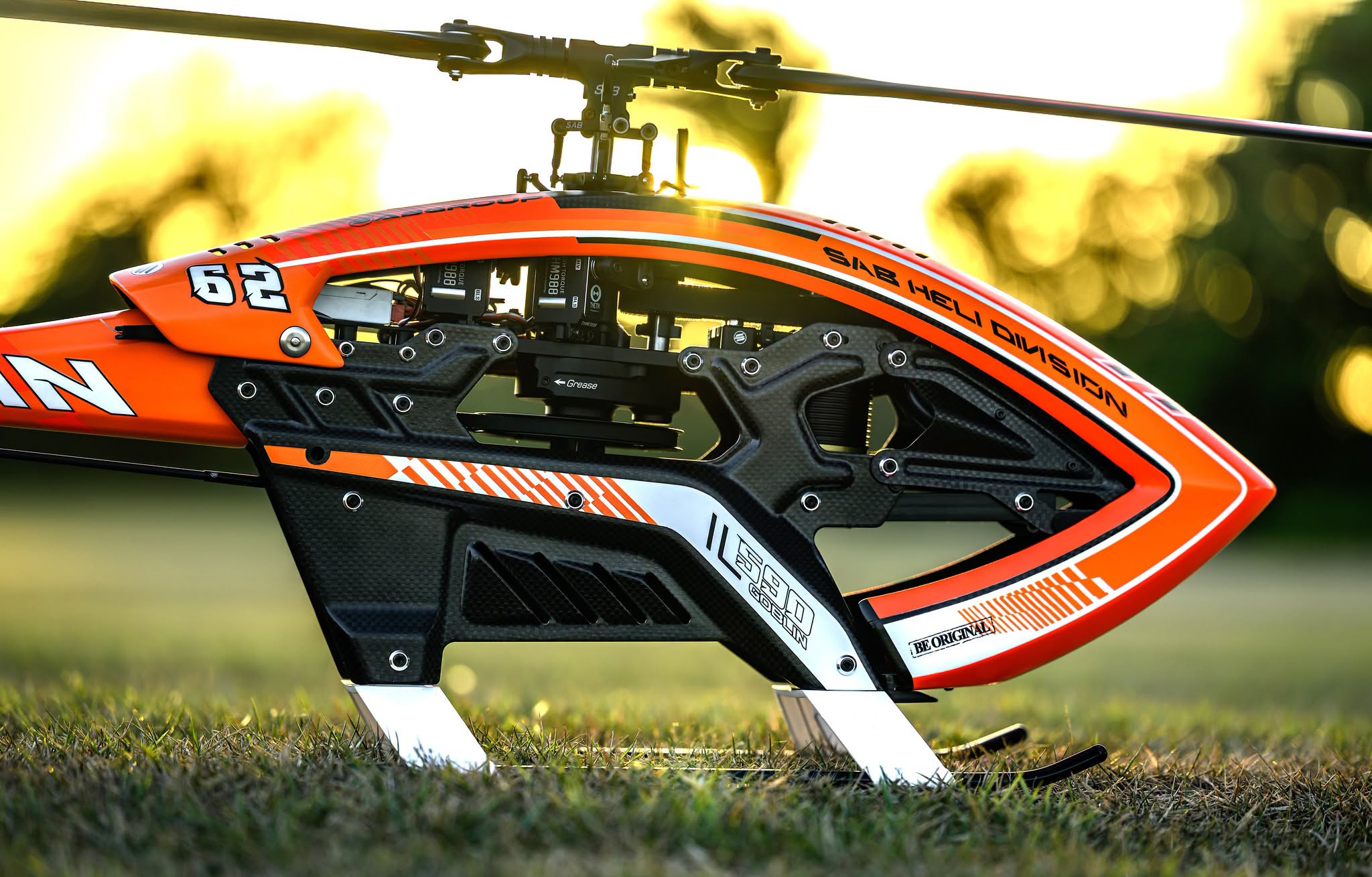
1. Executive Technical Summary
| Parameter | SAB Goblin 590 Specification |
|---|---|
| Helicopter class | 550 / 600 class hybrid |
| Main blade length | 580–600 mm |
| Main rotor diameter | Approximately 1,308 mm (with 580mm blades) / 1,348 mm (with 600mm blades) |
| Overall length with canopy | Approximately 1,170 mm |
| Overall height | Approximately 358 mm |
| Overall width | Approximately 196 mm |
| Airframe weight without electronics/battery | Approximately 2.15–2.25 kg (Estimated ready-to-fly approx. 3.4–3.8 kg depending on pack choice) |
| Main shaft diameter | 10 mm hardened steel |
| Feathering shaft diameter | 8 mm |
| Tail shaft diameter | 5 mm |
| Main pulley / Transmission type | SAB dual-stage modular belt drive / Transmission pulley system |
| Standard motor pulley | 20T / 22T options depending on motor KV and setup |
| Tail belt transmission | Timing belt driven from main gear assembly with front/rear pulleys |
| Tail blade length | 95 mm to 105 mm |
| Tail rotor diameter | Approximately 260–280 mm |
| Battery configuration | 6S to 12S LiPo supported depending on setup (Standard 6S 5,000–6,000mAh or 12S setup variant) |
| Recommended motor class | 4025 / 4030 / 4225 brushless outrunner (approx 500–560KV for 12S or 1,100KV for 6S) |
| Recommended ESC | 120A to 140A (6S) or 80A–120A (12S) |
| Cyclic servos | 3 × standard/full-size servos |
| Tail servo | 1 × standard/full-size high-speed tail servo |
| Flight controller | Universal Flybarless (FBL) system compatibility |
2. Airframe Dimensions
| Dimension | Metric | Imperial |
|---|---|---|
| Overall length | 1,170 mm | 46.06 in |
| Overall height | 358 mm | 14.09 in |
| Overall width | 196 mm | 7.72 in |
| Main rotor diameter (580mm blades) | ~1,308 mm | ~51.50 in |
| Main rotor diameter (600mm blades) | ~1,348 mm | ~53.07 in |
| Tail blade length | 95 mm | 3.74 in |
| Tail rotor diameter | ~260 mm | ~10.24 in |
| Tail boom diameter | 25 mm carbon fiber | 0.98 in |
3. Rotor System & Head Architecture
Main Rotor
- Main blade operating range: 580 mm to 600 mm
- Main shaft diameter: 10 mm
- Feathering shaft diameter: 8 mm
- Flybarless aluminum rotor head with rigid dampening setup
- Adjustable geometry swashplate designed for high-resolution cyclic control resolution
The Goblin 590 rotor head follows SAB’s classic ultra-low profile design philosophy, minimizing the distance between the main rotor disc and the main shaft bearings to reduce cyclic pitching moments and enhance agility during sudden directional reversals.
4. Transmission and Pulley Ratios
SAB helicopters utilize a distinctive belt-driven transmission system rather than traditional spur gears, providing inherent shock-load absorption during aggressive collective pitches or sudden blade strikes.
| Transmission Component | Specification / Teeth Count |
|---|---|
| Motor Pulley (Standard options) | 20T / 22T (Dependent on motor shaft and KV) |
| Internal Transmission Pulley Stage | Multiple stage belt reduction |
| Tail Ratio Calculation | Configured via front and rear pulley ratios yielding standard tail speeds ~4:1 to 4.5:1 relative to main rpm |
5. Tail Transmission and Belt Drive
The tail system relies on a high-strength elastomer-reinforced timing belt running through the 25mm carbon fiber tail boom.
- Tail shaft diameter: 5 mm
- Tail blade length compatibility: 95 mm to 105 mm
- Dual-support tail pitch slider mechanism running on a hardened steel spindle for slop-free yaw response.
6. Power System & Motor Recommendations
The Goblin 590 can be configured in multiple power variants depending on pilot preference for flight duration versus raw power-to-weight ratio:
- 6S Setup: Typically utilizes a high-torque 4025-class motor around 1,100 KV paired with a 5,000–6,000 mAh LiPo pack. Favored for lighter disc loading and relaxed sport or smooth 3D flight.
12S Setup: Utilizes a lower KV motor (approx. 500–560 KV) powered by dual 6S packs in series (e.g., 3,300–3,700 mAh). Provides exceptional voltage efficiency, lower current draw, and immense torque headroom for hard 3D maneuvers.
7. Rotor Disc Area & Disc Loading Calculations
Using a standard 580 mm blade configuration:
  Main Rotor Diameter = 1.308 m
            Rotor Radius (r) = 0.654 m
            Disc Area (A) = π × r²
            A = π × (0.654)² ≈ 1.34 m² (approx 14.4 ft²)
Assuming an estimated ready-to-fly (RTF) weight of approximately 3.6 kg (35.3 N):
  Disc Loading = Force / Area
            Disc Loading = 35.3 N / 1.34 m² ≈ 26.3 N/m² (approx 2.68 kg/m²)
8. Typical Operating Headspeeds
| Flight Regime / Mode | Target Headpseed Range |
|---|---|
| Low Headspeed / Scale / Long Duration | 1,700 – 1,900 RPM |
| Normal Sport Flight | 2,000 – 2,200 RPM |
| Hard 3D / Extreme Performance | 2,300 – 2,500 RPM |
*Note: Operating above 2,500 RPM with 600mm blades requires strict component inspection, high-grade hardware verification, and consideration of centrifugal load limits on blade grips and feathering shafts.*
9. Servo and Electronics Layout
| Control Surface | Required Servo Class |
|---|---|
| Cyclic (Elevator / Ailerons) | 3 × Standard full-size high-voltage (HV) digital metal-gear servos |
| Tail / Rudder | 1 × Standard full-size high-speed narrow-band or digital HV tail servo |
10. Recommended Technical Database Structure
For maintenance tracking and flight-log correlation, data for the Goblin 590 should be logged across three distinct categories:
Factory Specifications
Stock gear ratios, designated part numbers, factory manual torques, and stock blade dimensions provided by SAB Heli Division.
Measured Setup Data
Actual component weights, precise CG adjustments, battery pack internal resistance logs, and individual servo telemetry outputs.
Calculated Performance Data
Theoretical headspeeds derived from motor KV, pack voltage under load, and transmission ratios.
11. Final Technical Notes
The SAB Goblin 590 remains a benchmark platform for pilots looking to step up from 550-size maneuverability into the stability and presence of a larger machine without committing to the heavy infrastructure and battery costs of a full 700-class setup. Keeping meticulous track of belt tension, one-way bearing maintenance, and headspeed limits ensures long-term reliability and peak aerodynamic performance.