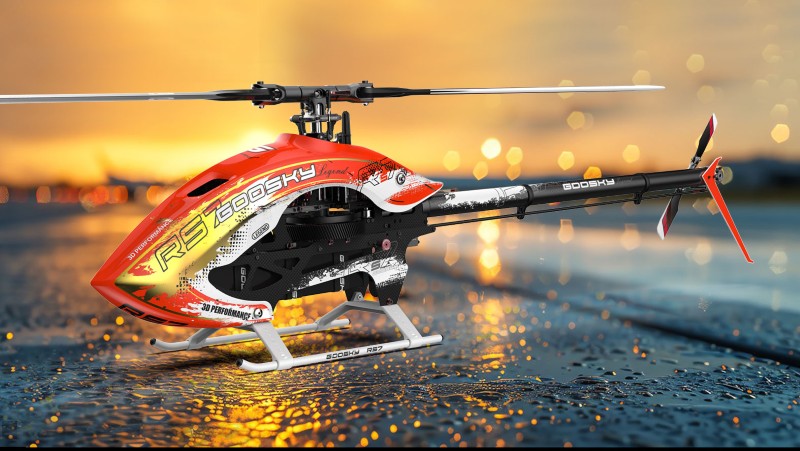
Goosky RS4 Venom Technical Dossier
01
Aircraft Overview & Class Specifications
Engineered to bridge the gap between micro helis and heavy 550/700-class airframes, the Goosky RS4 Venom prioritizes structural rigidity, low part-count mechanical simplicity, and high power-to-weight efficiency.
| Specification Parameter | Design Target / Value |
|---|---|
| Aircraft Class | 380 / 400-Size Electric 3D Helicopter |
| Main Rotor Blade Length | 380mm – 384mm |
| Tail Rotor Blade Length | 68mm – 70mm |
| Power System Configuration | 6S LiPo (22.2V Nominal) |
| Target Headspeed Range | 3,200 RPM (Sport/Big Air) to 3,800+ RPM (Hard 3D / Extreme Agility) |
| Drivetrain System | Helical Main Mesh + Belt-Driven Tail Rotor |
02
Mechanical & Frame Architecture
Airframe & Chassis Construction
- Integrated Monocoque/Split Frame: High-grade composite side plates paired with precision CNC-machined 6061-T6 aluminum structural inserts. This hybrid geometry optimizes torsional rigidity under high-g collective pitch pumps while dampening high-frequency motor harmonics.
- Battery Tray Integration: Quick-release slide-in battery tray system with positive-lock retention, ensuring zero-play mass centralization and rapid pack swaps at the flight line.
Rotor Head Geometry
- Rigid DFC / Semi-FBL Head Design: Features an ultra-low center of gravity (CG) rotor head. Linkage geometry is optimized for direct, zero-slop mechanical response, minimizing phase lag and maximizing error-correction speed for modern flybarless (FBL) flight controllers.
- Spindle & Dampening: Heavy-duty hardened steel main shaft and spindle shaft, utilizing high-durometer elastomer dampers designed to handle high-frequency cyclic inputs without sacrificing precision tracking in high-load wind conditions.
Drivetrain & Tail System
- Main Drivetrain: High-efficiency helical main gear mesh designed for smooth torque transfer, reduced noise profile, and maximized tooth engagement surface area.
- Tail Drive Architecture: Robust belt-driven tail system. Eliminates gear-mesh binding issues common in micro torque-tube designs, offering superior crash survivability, shock absorption during aggressive tail reversals, and simplified maintenance.
- Tail Pitch Mechanism: Dual-supported tail slider on a precision-ground stainless steel shaft with angular contact thrust bearings, eliminating tail binding under extreme loading.
03
Power System & Electronics Integration
Power System Note
Pairing the RS4 Venom with a high-bandwidth digital governor is essential for maintaining precise headspeed lock through aggressive collective pumps on 380mm rotor discs.
Motor & ESC Selection
- Recommended Motor: High-torque outrunner brushless motor (Goosky direct-match or 2828/3215 class) optimized for high magnetic flux density and rapid transient response on 6S LiPo setups.
- Electronic Speed Controller (ESC): 60A to 80A ESC (such as Hobbywing Platinum series or equivalent) featuring high-speed fast-response governor loops.
FBL Gyro & Radio Compatibility
- Flybarless Controller Integration: Fully compatible with modern high-speed FBL units (Rotorflight 2.x, Spirit Systems, MicroBeast, Spektrum FC6350HX) operating at high loop rates (2kHz–4kHz).
- Cyclic Servos: Micro metal-gear digital servos featuring high transit speed (≤ 0.05 sec/60°) and high stall torque to handle aerodynamic moments across 380mm blades.
- Tail Servo: Full-size or high-performance micro tail servo optimized for narrow-pulse operation (760us / 1520us) for instantaneous stop and hold characteristics.
04
Flight Dynamics & Tuning Profile Notes
Cyclic Response & Agility
The low CG head and tight linkage geometry result in virtually zero roll-pitch coupling during rapid piro-flips and tic-tocs.
PID Tuning Baseline (Rotorflight / Modern FBL)
- P-Gain: Keep moderate-to-high to maintain a locked-on feel without inducing high-frequency oscillation on the 380mm disc.
- D-Term: Essential for damping out quick stop oscillations after hard cyclic snaps.
- Feedforward (FF): Tune to taste for stick-following crispness, ensuring snappy transitions without biting into mechanical limits.
Tail Performance Optimization
The belt-driven tail combined with a high-speed tail servo yields exceptional holding power in full-power backwards maneuvers and high-load funnel entries. Tail dynamic gain can typically be run at higher percentages compared to gear-driven counterparts due to the compliance and damping inherent in belt drives.