GooSky RS5 Ultra 550Technical Engineering Dossier Technical Reference • 550/560-Class Electric Competition Helicopter |
Model: GooSky RS5 Ultra 550
Category: 550/560-class high-performance electric flybarless RC helicopter
Primary Intended Use: Hard 3D aerobatics, high-precision flight, and high-load 6S operational setups.
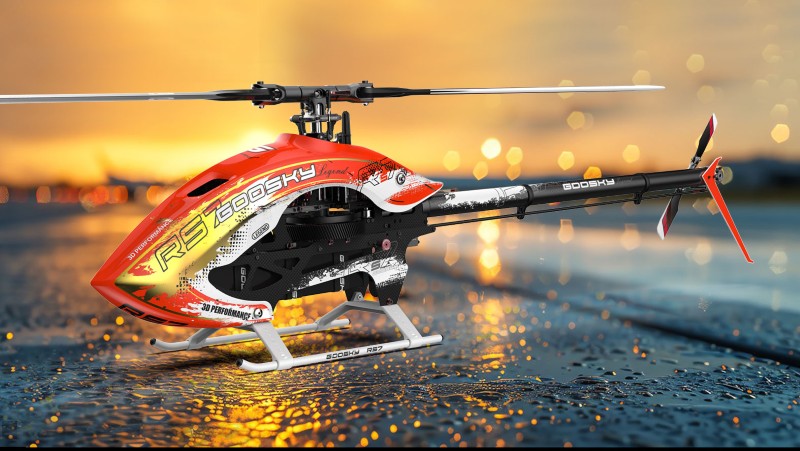
The GooSky RS5 Ultra builds upon the legacy RS5 architecture with heavy structural upgrades. Featuring a robust 12mm main shaft, a reinforced 116T main gear, 1:1 flybarless rotor head geometry, a symmetrical cyclic servo layout, and an automatic belt-tensioning tail system, the Ultra is built to absorb extreme loads.
1. Executive Technical Summary
| Parameter | RS5 Ultra Specification |
|---|---|
| Helicopter class | 550/560 Class |
| Main blade length | 560 mm (Azure Power supplied in combo) |
| Main rotor diameter | Approximately 1,272 mm |
| Overall length | 1,157-1,159 mm |
| Overall height | 320-326 mm |
| Overall width | 203 mm |
| Airframe weight (bare) | Approximately 2.68 kg |
| Main shaft diameter | 12 mm (GT220008) |
| Feathering shaft diameter | 8 mm (GT060008) |
| Main gear | 116T (GT220013) |
| Motor pinions | 13T (Standard), 12T (Low-speed), 14T (High-speed optional) |
| Tail drive transmission | 75T front pulley / 16T rear pulley (4.69:1 ratio) with 6 mm belt |
| Tail shaft / Spindle | 6 mm one-piece tail shaft / 5 mm tail spindle |
| Recommended battery | 6S LiPo (5,000-6,000 mAh) |
| Recommended motor | 4025 or GooSky 4225 (1,100-1,150 KV) |
2. Rotor Head & 1:1 FBL Geometry
The RS5 Ultra incorporates elite structural head components engineered for direct feedback:
- 1:1 FBL Rotor-Head Geometry: Establishes a direct linear relationship between swashplate motion and blade pitch without mechanical scaling curves, sharpening cyclic response.
- Oversized Swashplate: CNC-machined aluminum swashplate built to resist angular deflection under heavy collective reversals.
- Self-Lubricating POM Spacers: Dedicated blade-grip components feature self-lubricating POM spacers (Part GT220002) for friction-free grip rotation.
- Replaceable Pitch Arms: Modular design allows direct replacement of pitch control arms (Part GT220003) without replacing entire grips.
3. Main Gearing & Reduction Ratios
| Pinion Selection | Tooth Count | Reduction Ratio | Operational Effect |
|---|---|---|---|
| Low-Speed Pinion | 12T | 9.66:1 | Higher torque multiplication, ideal for lower headspeeds and extended flight times. |
| Standard Pinion | 13T | 8.92:1 | Factory balanced setup for all-around 3D performance. |
| High-Speed Pinion | 14T | 8.29:1 | Max rotor rpm capability for extreme speed and aggressive power bursts. |
4. Tail System & Automatic Belt Tensioner
The RS5 Ultra tail assembly introduces major geometric and mechanical refinements:
- Raised Tail Rotor Plane: The tail output shaft is raised by ~14% compared to the baseline RS5, aligning the tail thrust closer to the main rotor disc to minimize pitch coupling during pirouettes.
- Automatic Belt Tensioner: Features a front belt tensioner module (GT220020) and adjuster (GT220074) to maintain optimal 6 mm belt tension across thermal expansion cycles.
- Robust Tail Assembly: Supported by a rigid 6 mm one-piece tail shaft, 75T front pulley, 16T rear pulley (4.69:1 ratio), and 95 mm tail blades spinning on a ~260 mm tail rotor diameter.
5. Symmetrical Servo Layout & Power System
- Symmetrical Cyclic Layout: Three full-size cyclic servos are symmetrically arranged to ensure uniform swashplate travel and eliminate differential throw across axes.
- Servo Specs (Combo): Compatible with full-size high-torque digital servos (e.g., GooSky DS410MG / DS320MG tail servo operating at 6.0-8.4V).
- Power Architecture: Tailored for 6S LiPo operation utilizing a 4025 / 4225 (1100-1150 KV) brushless motor paired with a 130A-150A high-performance ESC.
Dossier Verdict
The GooSky RS5 Ultra 550 bridges the gap between lightweight 550 trainers and heavy 700-class engineering. With its 12mm main shaft, 116T gear, 1:1 head geometry, and automatic belt-tensioning tail, it provides elite 3D performance tailored for demanding 6S pilots.
Our staff (RC FlightPath) has personally flown this helicopter. With the proper component selection, configuration setup, and PID tuning, it has shown to be one of the most precise helicopters we've tried to date.