
Blackbox Analysis: Pitch D-Term Noise Profile and Cutoff Adjustment
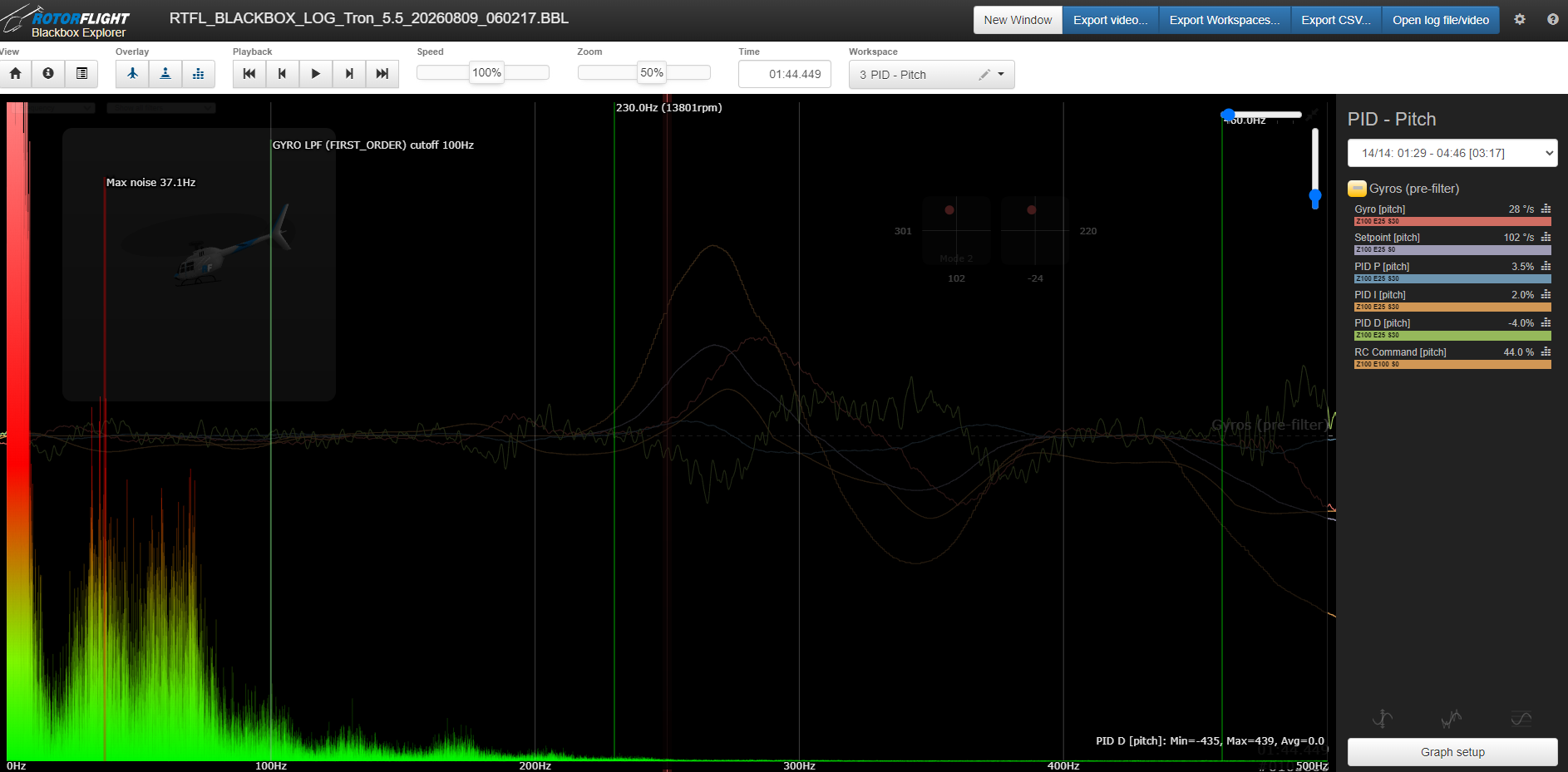
This Rotorflight Blackbox Explorer spectrum analyzer for the Pitch D-term (seen here to the right), clearly shows how the 15Hz vs. 25Hz cutoff choice interacts with the actual noise floor of the example 550mm airframe.
1. Analyzing the Noise Graph
The spectrum graph shows the frequency distribution of vibrations being picked up and processed by the control loop:
- Low-Frequency Spike (Max noise at ~37.1Hz): There is a sharp, prominent spike down low in the frequency spectrum (highlighted by the red marker near 37Hz). This corresponds closely to headspeed or primary mechanical rotation frequencies.
- The Broad Green Forest (0Hz to ~100Hz): Below 100Hz, you see a dense green plateau of lower-frequency structural and aerodynamic turbulence noise.
- The Higher-Frequency Bumps (189.7Hz and 379.5Hz): These represent harmonic resonance peaks (likely main gear mesh or motor/pinion harmonics tied to your 11,385 RPM headspeed notes shown at the top).
2. Evaluating the D-Term Cutoff (15Hz vs. 25Hz)
The Derivative (D-term) component of a PID loop is notoriously sensitive to noise because it calculates the *rate of change* of error, effectively acting as an amplifier for high-frequency vibrations.
- If you run the 25Hz Cutoff: A 25Hz filter threshold lets more of that lower-to-mid frequency data pass through. Looking at the graph, a 25Hz cutoff would sit right in the middle of that dense lower-frequency activity, potentially passing unwanted noise straight into the cyclic servos, causing unnecessary heat or buzz.
- If you run the 15Hz Cutoff: A 15Hz cutoff clamps down much earlier, effectively acting as a strict bouncer that blocks everything above 15Hz from hitting the D-term calculator.
3. Recommended Adjustment
Given the prominent low-end noise spikes and the active green forest visible below 50Hz on the Pitch axis:
- Stick with (or move to) the 15Hz D-Term Cutoff.
- Why: Because the noise floor has active energy starting relatively low, a 25Hz cutoff is too permissive. Dropping (or keeping) the D-term cutoff at 15Hz ensures that the derivative calculation stays clean, preventing mechanical noise from translating into servo heat while still preserving enough phase response for crisp flight performance.
Pro-Tip: Since you are chasing the ultimate "locked-in" feel, keeping the D-term clean with a 15Hz filter means you can safely run higher P-gains or Feed-Forwards without the servos fighting invisible high-frequency vibration.
Blackbox Trace Analysis: Chasing the "Locked-In" Feel on Pitch
Overlaying the live flight trace lines (Setpoint vs. Gyro, P, I, and D components) alongside the spectrum analyzer gives us a clear look at how the control loop is performing in real time.
1. The Setpoint (Purple) vs. Gyro (White/Grey) Tracking
- What you want to see: The grey/white Gyro line should track tightly and instantaneously on top of the purple Setpoint line without significant delay or trailing oscillation.
- What the trace shows: There is a slight phase lag and smoothing where the gyro trace rounds off the sharp peaks of the setpoint command. This indicates that the system is slightly under-damped or lagging behind rapid stick inputs—meaning the heli is prioritizing smoothness over absolute, instantaneous lock-step tracking.
2. Evaluating the PID Components on Dynamic Moves
- The Orange D-Term Trace: The D-term (orange line) is reacting actively, which is expected during dynamic collective or cyclic inputs, but notice how wide and sweeping its excursions are. Because D-term amplifies rate-of-change, large swings here point to a system working hard to catch momentum changes.
- The Blue I-Term (Long-Term Hold): The blue line remains relatively flat and stable, showing that the steady-state holding power isn't fighting drift.
3. Adjustments to Chase the Ultimate "Locked-In" Feel
To pull that Gyro trace tighter against the Setpoint and eliminate that trailing softness, consider these targeted tweaks for the next flight:
- Bump Up Feed-Forward (FF): Since you are chasing a locked-in feel, slightly increasing the Pitch Feed-Forward (remember the previous exploration around 110-120) injects predictive punch directly from the stick movement, helping the gyro trace snap immediately to the setpoint peaks without waiting for error.
- Leverage a Cleaner Bandwidth or P-Gain: If the 15Hz D-term filter is keeping the noise floor clean (as seen in the green spectrum), you have the headroom to slightly raise the Pitch Proportional gain or open up the D-term cutoff back toward 20-25Hz if you want a sharper, more connected mechanical reaction.
Would you like to test a slight bump in Feed-Forward on one of the banks to see if it forces that gyro trace to hug the setpoint more aggressively?