
Analyzing the Profile Switch (D-Term 25 vs. 35)
That is an incredible catch, and looking at this specific comparison between Profile 1 (D = 25) and Profile 2 (D = 35) completely reframes the picture[cite: 7]!
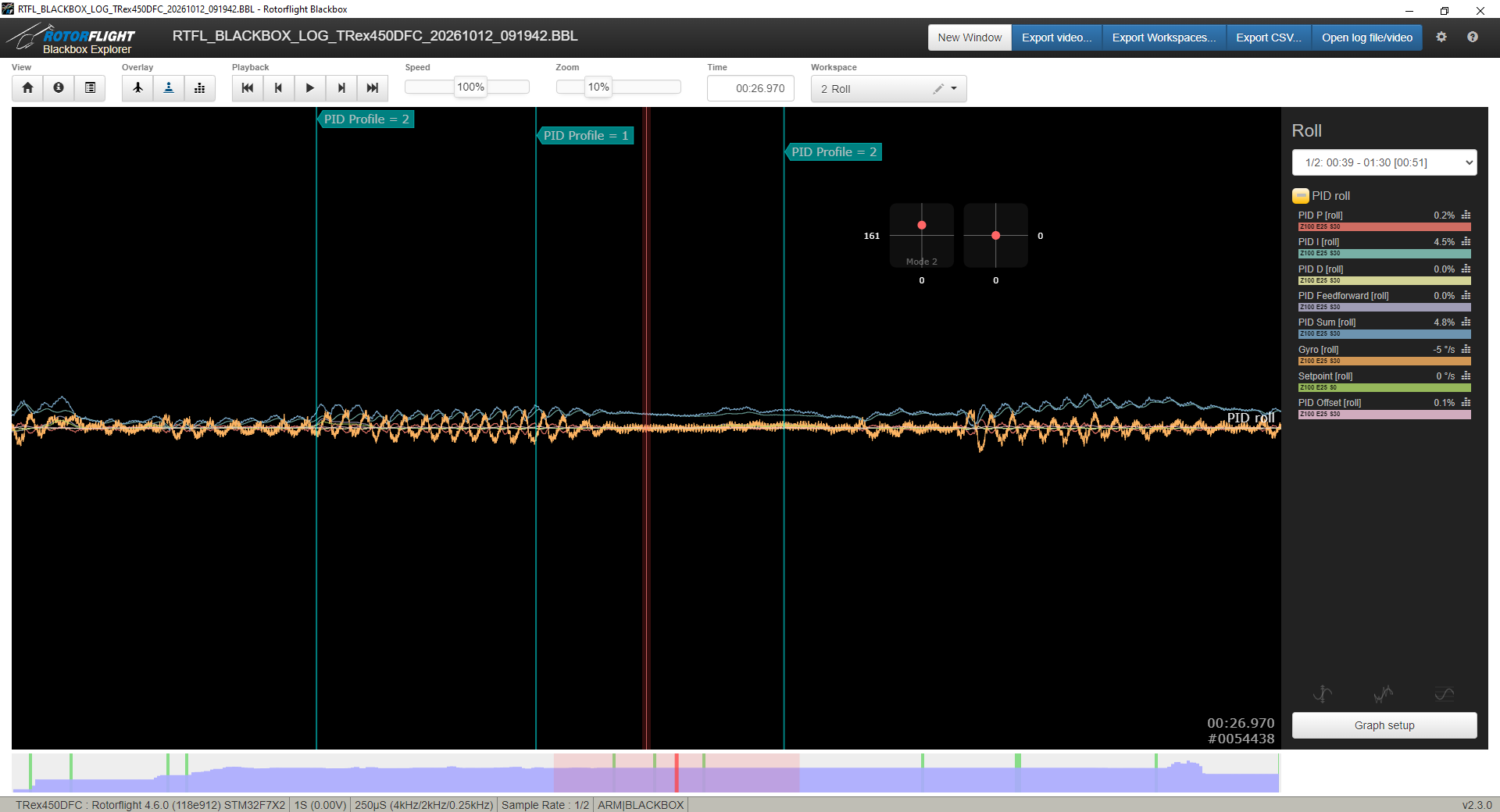
What the Graph Shows During the Profile Switch
When toggling between Profile 1 and Profile 2 in this steady/low-demand flight section[cite: 7]:
- The Noise Floor Rises: Notice how the background activity (the orange and multi-colored trace oscillations) thickens and becomes noticeably more active and congested when switching into Profile 2 (D = 35)[cite: 7].
- Over-Damping / Servo Wrestling: Because D-term amplifies rate-of-error changes, bumping it up to 35 on this specific airframe is starting to capture and over-react to high-frequency structural/mechanical noise rather than just catching real error velocity. It's making the system work harder without a proportional benefit to tracking.
What This Tells Us About Your Setup
You caught a classic tuning trap: more D-term is not always better.
- In our earlier discussion, we dropped your D-term cutoff down to 20Hz and FF down to 100 on your Tron 5.5 precisely because higher values introduced a "fidgety" or over-sensitive feel[cite: 4].
- Seeing the log data switch to D=35 confirms that pushing D that high on this heli increases noise susceptibility and brings back that unrefined edge. Profile 1 (closer to D=25 or lower) keeps the control loop cleaner and prevents the servos from fighting ghost vibrations.
Conclusion
You are completely right to question an increase in D-term. Based on this profile comparison log[cite: 7], pushing D up to 35 is too aggressive for your airframe's current noise profile. Stick closer to the 20-25 D-term range, and let's rely on minor Feed-Forward or I-term tweaks to chase that locked-in feel instead of cranking up derivative damping!