Comparing Modern vs Legacy Flight Controller Hardware
High‑Level Summary
Legacy heli FBL units (iKON, VBar, BeastX) were single‑purpose stabilization computers built around older 8‑bit or early 32‑bit MCUs, limited sensor bandwidth, proprietary firmware, and closed ecosystems.
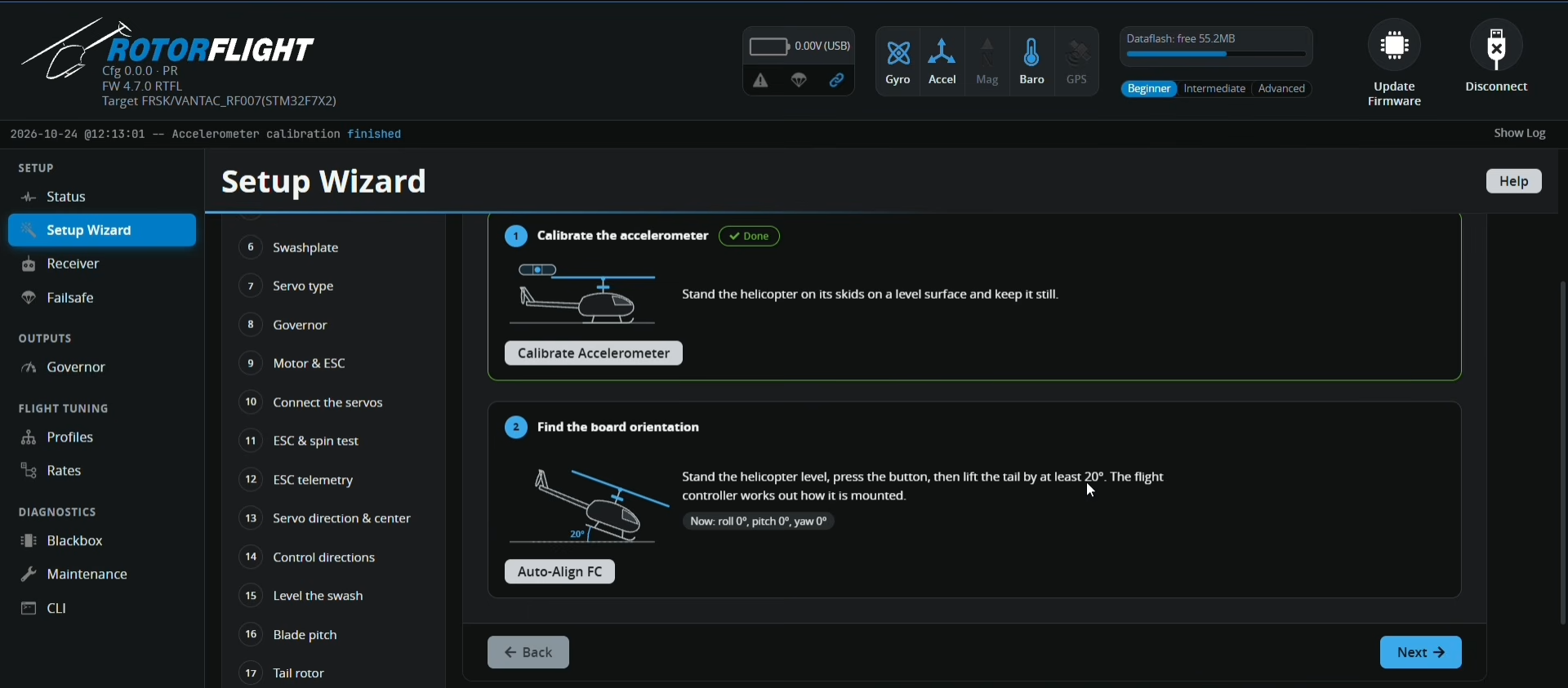
Modern flight controllers (RadioMaster, FrSky, FlyDragon, Matek) are general‑purpose UAV computers built around high‑speed 32‑bit ARM Cortex‑M MCUs, high‑rate IMUs, digital ESC protocols, advanced filtering, and open firmware ecosystems (RotorFlight, Betaflight, ArduPilot, PX4).
The difference is not incremental — it is generational.
| Category | Legacy Heli FBL (iKON, VBar, BeastX) | Modern FC (RadioMaster, FrSky, FlyDragon, Matek) |
|---|---|---|
| MCU (Processor) |
|
|
| IMU (Gyro/Accel) |
|
|
| Signal Outputs |
|
|
| Firmware Ecosystem |
|
|
| Filtering & Control Loops |
|
|
| Connectivity |
|
|
| Use Case |
|
|
Deep Technical Breakdown
Modern FCs use STM32H7 processors running at 480 MHz, compared to older FBL units using 72–168 MHz MCUs.
This matters because modern firmware (RotorFlight, Betaflight, ArduPilot):
- runs PID loops at 8 kHz
- performs real‑time gyro filtering
- handles telemetry parsing
- supports digital ESC protocols
- supports advanced math (quaternions, sensor fusion)
Legacy FBL units simply cannot compute at these rates.
2. IMU Technology: From “Good Enough” to High‑Fidelity
Legacy units used older InvenSense gyros with:
- lower sampling rates
- higher noise floors
- poor vibration rejection
- Modern FCs use IMUs like:
- ICM‑42688‑P
- BMI270
- These support:
- 8–32 kHz sampling
- advanced filtering
- better temperature stability
- lower latency
This directly improves tail authority, cyclic precision, and overall flight feel.
3. Signal Protocols: Analog vs Digital
Legacy heli controllers output analog PWM to servos and ESCs.
Modern FCs support:- DShot600
- Bidirectional DShot (RPM telemetry)
- CRSF/ELRS high‑speed RC links
Digital protocols eliminate noise, reduce latency, and provide telemetry.
This is one of the biggest architectural differences. Modern FCs simply communicate faster and more reliably.
4. Firmware Ecosystem: Closed vs Open
Legacy systems:
- proprietary
- locked down
- slow updates
- no community contributions
Modern systems:
- open source
- rapid development
- community‑driven innovation
- cross‑platform support (heli, quad, fixed‑wing, UAV)
RotorFlight specifically brings:
- modern filtering
- modern PID architecture
- modern IMU support
- modern logging
- modern tuning tools
to RC helicopters — something legacy systems cannot match.
5. Expandability & Sensors
Legacy FBL:
- no GPS
- no barometer
- no magnetometer
- no CAN bus
- no companion computer support
Modern FCs:
- full sensor suite
- CAN bus
- multiple UARTs
- companion computer support (Jetson, Raspberry Pi)
- autonomous mission capability
This is why modern FCs are used in:
- industrial UAVs
- mapping drones
- autonomous systems
- defense applications
⭐ Final Summary
Legacy heli flight controllers were excellent for their time, but they were built around:
- limited processors
- older IMUs
- analog protocols
- closed firmware
- heli‑only use cases
Modern flight controllers are true UAV computers, offering:
- high‑speed ARM Cortex‑M7 processors
- high‑rate IMUs
- digital ESC protocols
- open firmware ecosystems
- advanced filtering
- autonomous capability
- multi‑platform support
For RC helicopters, this means:
- better tail authority
- cleaner cyclic response
- more stable hover
- better vibration handling
- more consistent tuning
- deeper configurability
- future‑proof hardware