
Decoding Rotorflight Profile Parameters: Bandwidth, Cutoffs, and Gains
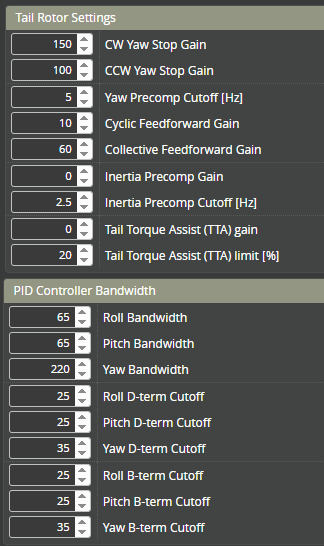
When diving into the Rotorflight profile pages, understanding how these three distinct parameter categories operate helps demystify what is happening under the hood of your flight controller.
1. What Increasing Overall PID Bandwidth Does
PID Bandwidth dictates how fast and wide-ranging the flight controller's error-correction loop is allowed to operate.
- The Effect: Increasing bandwidth essentially widens the "gate" for frequency response, allowing the PID controller to react much faster and tighter to high-frequency disturbances or rapid stick inputs.
- The Trade-off: While higher bandwidth delivers a sharper, more connected feel, pushing it too high on an airframe with mechanical noise or slop will translate that noise directly into the servos, causing heat, buzz, or oscillation.
2. What Parameters Involving "Cutoff" Do
Cutoff parameters (such as D-term cutoffs or filter frequencies) act as low-pass filters designed to draw a hard line against unwanted high-frequency noise.
- The Effect: Adjusting cutoff frequencies determines where the filter starts clamping down on signals. Raising a cutoff lets more high-frequency data pass through (making the system more reactive), while lowering it smooths out the signal by blocking high-frequency noise.
- The Interaction: Cutoffs are the safety counter-balance to Bandwidth. If you increase your PID bandwidth, you often have to manage your cutoffs carefully to ensure you aren't letting destructive mechanical vibrations through to the control surfaces.
Checkout this tuning example that evaluates the D-Term cutoff for Pitch and a relevant blackbox log.
3. What Parameters Involving "Gain" Do
Gain parameters (Proportional, Integral, Derivative, Feed-Forward, Boost, etc.) represent the multiplier of intensity applied to error correction or command delivery.
- The Effect: Gains dictate *how hard* the system fights to correct an error or match a stick input. Higher proportional or feed-forward gains force the servos to move faster and with more authority to achieve the target position.
- The Behavioral Impact: Unlike bandwidth (which controls speed of response across frequencies) or cutoffs (which filter noise), gains directly scale the physical muscle and aggression of the control loop. Too little gain leaves the heli feeling mushy; too much gain causes overshoot and violent oscillation.
Summary Comparison
| Parameter Type | Primary Function | If Increased Too Far |
|---|---|---|
| Bandwidth | Widens the response speed of the loop | Introduces mechanical noise, servo heat, and jitter |
| Cutoff | Filters out high-frequency noise above a set point | Can make the control loop feel sluggish or phase-lagged if set too low |
| Gain | Amplifies correction force and intensity | Causes sharp overshoot, bounciness, and violent oscillation |