Understanding Torque Tail Assist (TTA)
Mastering Motorized Tail Authority in Rotorflight Firmware
Introduction to Motorized Tails & TTA
In traditional radio-controlled (RC) helicopters, yaw control is managed via a variable-pitch tail rotor driven by a mechanical belt or torque tube linked directly to the main motor. However, many micro and mini RC helicopters use a simplified, lightweight configuration: a motorized tail rotor. While highly efficient and mechanically simple, motorized tails present unique control challenges that standard flybarless systems struggle to handle natively.
To overcome these limitations, Rotorflight firmware incorporates a specialized feature known as Torque Tail Assist (TTA)—historically referred to in community spaces as TALY (Torque Assist Left Yaw). TTA acts as an algorithmic bridge between the main governor and the tail control loop to ensure consistent heading hold during aggressive flight.
The Physics Problem: Asymmetric Authority
A conventional motorized tail rotor can spin exceptionally fast to counteract main rotor torque in one direction. In that primary direction, it delivers a massive amount of control authority. However, authority in the opposite direction is naturally reduced because the motor can only spin in a single direction. To rotate the helicopter in the weaker direction, the system relies on the motor slowing down or letting the main rotor's torque pull the frame around.
Core Concept: When a tail motor cannot slow down fast enough, or when aerodynamics push against the tail with high force, a temporary loss of tail authority occurs. This often results in a violent 90-degree to 180-degree "blowout" or swing.
How TTA Steps In
TTA adds critical control authority in the weaker direction by exploiting basic Newtonian physics: for every action, there is an equal and opposite reaction. When the flight controller detects a sudden demand for yaw authority that the tail motor cannot fulfill, it rapidly accelerates the main motor. This sudden surge of engine acceleration forces a powerful torque reaction on the helicopter frame in the opposite direction, snapping the heli's tail into place with incredible crispness.
Prerequisites Before Tuning TTA
Because TTA heavily relies on manipulating the throttle pipeline to generate torque spikes, you must establish a clean baseline on your helicopter before tweaking this parameter. According to official guidelines on Rotorflight's Governor Tuning Documentation, you should implement the following steps first:
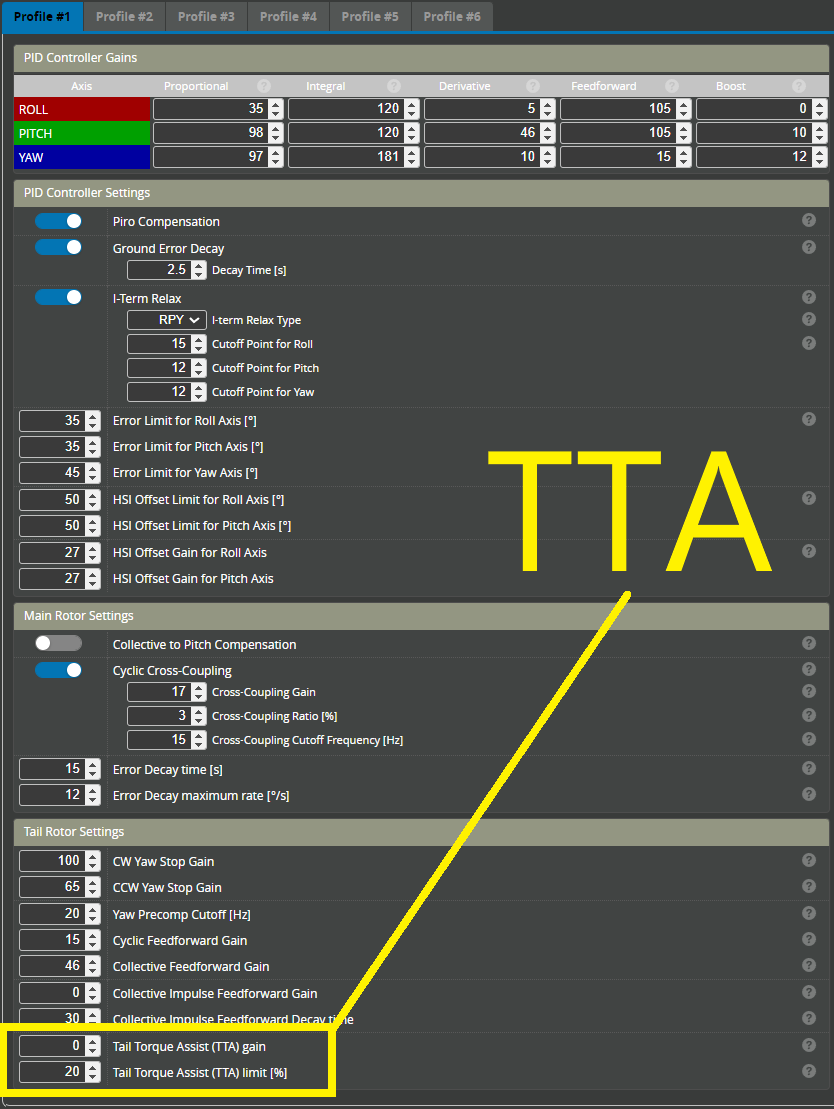
- Disable TTA Initially: Navigate to the Profiles Tab in the Rotorflight Configurator and set the TTA Gain value to
0. - Tune the Governor Baseline: Establish stable
P-gainandI-gainvalues for your main rotor governor so your headspeed is locked in under standard loads. - Configure Lowpass Filters: Ensure the
Cutoff for the TTA lowpass filteris configured adequately within your Governor Profile settings to allow swift but smooth interactions.
Step-by-Step TTA Tuning Protocol
Tuning TTA requires pushing the aircraft into flight envelopes where aerodynamic forces intentionally overcome the tail motor's standalone authority.
Step 1: Test Flight & Diagnostic Maneuver
Take off and safely transition into high-speed backward flight with the tail moving directly into the wind. If the tail lacks authority, the heli will suddenly execute a sharp, uncommanded rotation (often swinging 180 degrees into a tail-first profile).
Step 2: Incremental Gain Adjustments
Land the helicopter and access the Rotorflight Profiles Tab via your laptop or transmitter LUA scripts. Raise the TTA gain value in increments of 10. Repeat the test flight until the sudden high-speed backward blowing-out behavior stops.
Step 3: Advanced Aerodynamic stress testing
Sometimes, a helicopter will handle straight backward flight cleanly but will still falter during complex, high-energy physics transitions. Test your TTA settings using these two critical maneuvers:
- Tail Slides: Fly vertically upward, stop, and let the helicopter slide backward straight down toward the ground tail-first.
- Backwards Loops: Execute large, looping arcs while maintaining a constant tail-first direction relative to your flight path.
If the helicopter flips out or kicks during the apex of these maneuvers, continue raising the TTA gain incrementally until the behavior is mitigated.
Hardware Limitations & Expectations
Realistic Expectations: It is highly possible that you will never completely clear 100% of the tail swing during extreme maneuvers on certain micro-helicopters.
A prime real-world example is the popular original OMP M2 helicopter. Even when pushed to its maximum software TTA gain, the tail can still break loose under excessive loads. This isn't a failure of the Rotorflight firmware; rather, it is a physical limitation of the hardware. If the main motor lacks the physical "beefiness" or rotational mass to transfer an immediate, massive torque spike to the airframe, the software cannot entirely compensate for the mechanical shortfall.