
The KBar Flybarless Gyro Guide
An in-depth analysis of hardware variants, software configuration, reverse-engineering origins, and community troubleshooting.
1. Introduction & Background
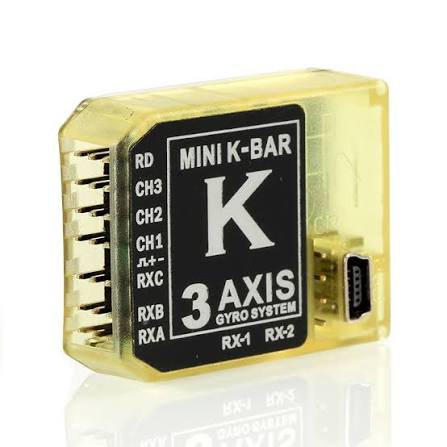
The KBar (commonly available in variants like the Yellow Mini KBar, Blue Mini, and Gold Warrior Full Size) emerged in the radio-controlled (RC) helicopter community as a budget-friendly alternative to premium flybarless (FBL) stabilization systems. Widely regarded as a clone or derivative inspired by Mikado's VBar and VStabi software ecosystem, the KBar provides advanced stabilization, governor support, and vibration analysis at a fraction of the cost.
Community discussions highlight that while budget units like the Tarot ZYX-S offered early alternatives, the KBar series gained immense popularity because it interfaces directly with the intuitive Mikado VStabi PC software.
2. Hardware Variants & Technical Teardown
As documented across extensive user teardowns and builder reports, KBar units are manufactured in multiple configurations (Yellow Mini, Blue Mini, and Gold Warrior Full Size), each featuring distinct internal layouts and sensor configurations:
| Variant | Sensor / Chip Architecture | Key Characteristics |
|---|---|---|
| Yellow Mini KBar | Replaced discrete analog sensors with a 3-axis digital sensor paired with a small onboard microprocessor. | Features a push button (often accessible via a pinhole) primarily used for mounting orientation configuration. |
| Gold Warrior (Full Size) | Invensense MPU-3050C digital 3-axis gyro chip combined with an epoxy-covered secondary microprocessor. | Separates the main unit from a remote sensor. The MPU-3050 outputs a combined serial digital X/Y/Z data stream, which the secondary processor translates into signals expected by the main CPU. Features flawless soldering and precise case fitment. |
| Blue Mini | Standard mini FBL configuration. | Widely utilized on 450 to 550-size helicopters, though note that tail gain scaling can differ significantly compared to the yellow variants. |
3. Software Setup & Version Challenges
Configuring a KBar requires careful management of the PC software environment. Because these units leverage VStabi architecture, official software updates can trigger license checks or firmware verification that bricks non-genuine units.
- Safe Software Versions: Community standard practice established using stable offline versions (such as VStabi 5.3.4) and specialized "non-phone home" builds to prevent the unit from locking or rejecting serial validation.
- Driver Installation Hurdles: Many users on Windows 7 and Windows 8 (64-bit systems) experienced prolonged troubleshooting getting USB drivers to recognize the KBar. The most reliable workaround involves manually pointing the device manager directly to the unzipped driver folder or certificate package rather than executing automated installers.
4. Wiring and Receiver Integration
Wiring the KBar correctly is critical to prevent hardware damage. Standard configurations utilize remote satellite receivers (such as Lemon-Rx DSMX satellites plugged directly into the side ports) or standard receiver signal harnesses:
- RX A: Triple I/O signal connection carrying Aileron, Elevator, and Rudder signals from a standard receiver. Note: Do not supply primary RC receiver voltage through RX A.
- RX B: Collective pitch control and primary power supply.
- RX C: Gyro gain control channel and power supply.
- RD: Tail rotor servo output.
- Ch1 - Ch3: Swashplate servo outputs.
5. Tuning, Vibration Analysis, and Troubleshooting
Pilot logs and field reports emphasize that mechanical setup must be perfected before tweaking software parameters:
- Tail Wag & I-Gain: A common issue reported by builders is a "happy dog" tail wag in Heading Hold (HH) mode. Lowering the integral gain (I-gain) or adjusting stop gains (Stop Gain A & B) typically resolves oscillation during stops and hovers.
- Vibration Logging: The VStabi vibration analysis tool allows pilots to run diagnostics (often recommended with main blades removed or using long USB tether safety precautions). Spikes observed in vibration logs help isolate mechanical imbalances in tail shafts, motor gears, or main rotors.
- Optimizer Features: The control loop optimizer should be utilized conservatively-typically enabled for only 1 to 2 test flights involving pirouettes and hard stops before disabling it again to avoid erratic flight feel.
6. Conclusion
Despite initial setup complexities and driver hurdles, the KBar has proven to be an astonishingly capable and cost-effective flybarless solution for RC helicopter enthusiasts scaling from 450 micro classes up to 600-size nitro and electric scale builds. Meticulous attention to mechanical alignment, correct driver installation, and conservative gain tuning ensure stable, locked-in performance.