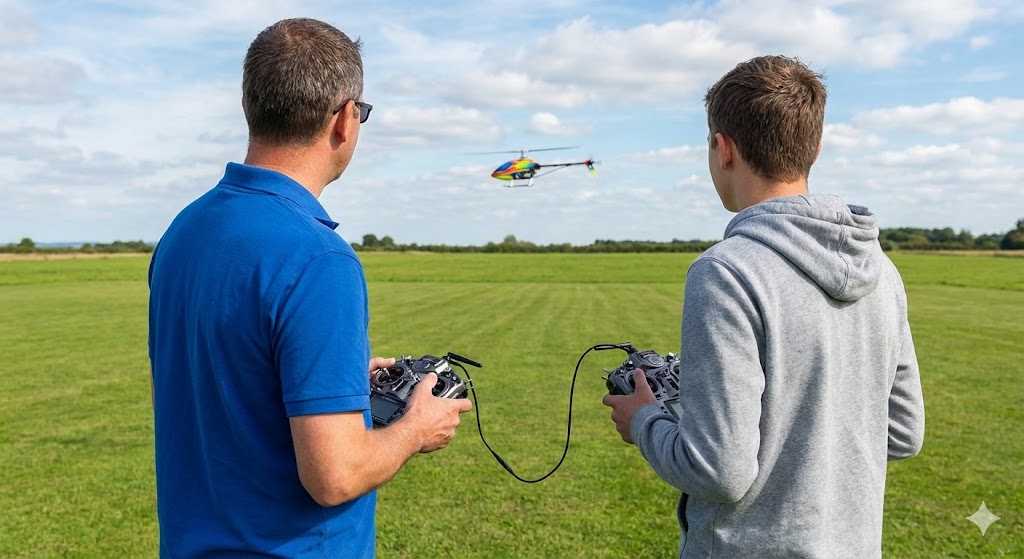
Learning RC Flight Faster: Thinking on Paper and Training Your Brain
Flying radio-controlled aircraft is one of the most demanding multitasking skills a hobbyist can learn. You’re managing orientation, throttle, cyclic, rudder, airspeed, altitude, and spatial awareness—all at once. At first, it feels like learning to drive a car or ride a bike: awkward, overloaded, and mentally exhausting. Over time, with the right kind of practice, it becomes automatic. This article explains how thinking on paper can dramatically accelerate that process.
Why RC Flight Feels Overwhelming at First
When you start flying RC aircraft, your brain is trying to juggle too many “dots” at once: stick positions, aircraft response, wind, distance, and orientation. As the original author of the thinking-on-paper method explains, “as you get more information and there are more pieces of the puzzle you're trying to balance inside your head, your brain is finding it harder to hold on to all of that information.”
In RC flight, those “pieces of the puzzle” are control inputs and their consequences. If you try to keep all of that in your head while learning, you hit confusion and overwhelm quickly. That’s when many pilots stall out, plateau, or develop bad habits.
The goal is not to avoid that mental load, but to process it correctly so your brain can build stable control patterns—just like learning to drive or ride a bike.
Thinking on Paper: Turning RC Practice Into Real Learning
The core idea from the video (located at the bottom of this article) is simple: “thinking on paper” means using writing not just to record information, but to organize and process it. The author warns that simply writing everything down without structure “directly bypasses all of the useful cognitive processes that would allow you to turn this information into true knowledge.”
For RC pilots, this means we don’t just log flights or jot random notes. We use paper (or a tablet) as a deliberate tool to:
- Capture what we’re working on (e.g., “upright hover facing me,” “left-hand circuits”).
- Connect those tasks to specific stick movements and aircraft responses.
- Refine our understanding over time as we notice patterns and correct mistakes.
The Three Principles Applied to RC Flight
1. Make It Wrong: Get the Puzzle Pieces on Paper
In the video below, the first rule is “make it wrong.” You don’t wait until you fully understand a topic before writing; you write early, imperfectly, and use the page to figure things out. For RC flight, this looks like:
- After a session, quickly write down key moments: “heli drifted left in hover,” “over-corrected on elevator,” “lost orientation when nose-in.”
- Write keywords, not essays: “nose-in hover,” “left drift,” “late rudder,” “over-input cyclic.”
- Guess at relationships: “left drift → not enough right cyclic,” “nose-in confusion → weak mental model of controls when reversed.”
You might be wrong about why the aircraft behaved a certain way—but that’s fine. The act of guessing and putting it on paper primes your brain to notice the correct patterns next time you fly.
2. Make It Shorter: Distill Your RC Lessons Into Keywords
The second principle is “make it shorter.” Long, detailed notes often feel productive but actually slow down learning. The video points out that “the level of retention and depth of understanding that you have goes down as your word count goes up… it takes more thinking to summarize something into a keyword than it does into a full sentence.”
For RC training, this means:
- No full sentences in your practice log—just compact tags.
- Examples: “hover: stable tail-in,” “nose-in: panic,” “circuits: altitude drift,” “landings: flare too late.”
- Use 3–5 keywords per session to capture the essence of what happened.
These short notes become mental anchors. When you review them, your brain recalls the full experience and starts connecting sessions together into a coherent skill progression.
3. Make It Again: Reorganize Your Understanding as You Improve
The third principle—“make it again”—is where most of the learning power comes from. The author explains that reorganizing and cleaning up your notes “is actually where the benefit of the learning is going to come from.”
Applied to RC flight:
- Every few sessions, redraw your understanding of your skills on a fresh page.
- Group skills: “Orientation,” “Hover,” “Circuits,” “Landings,” “Emergency recovery.”
- Place your keywords under these groups and adjust them as your understanding changes.
- Move items around when you realize something was misclassified (e.g., a “hover problem” is actually an “orientation problem”).
This reorganization mirrors what your brain is doing internally: correcting models, strengthening connections, and turning scattered experiences into a stable skill set.
Multitasking in RC Flight: Training the Brain Like Driving or Cycling
Controlling an RC aircraft is a classic multitasking problem. At first, you consciously think about every stick movement and every response. It feels slow, clumsy, and mentally heavy—just like the first time you drove a car or rode a bike.
Over time, with repeated practice and good mental models, your brain:
- Automates basic control loops (e.g., keeping altitude, holding heading).
- Frees up attention for higher-level tasks (pattern, traffic, wind, safety).
- Builds “muscle memory” for stick movements tied to visual cues.
Thinking on paper accelerates this transition from conscious multitasking to semi-automatic control. By externalizing your confusion, guesses, and corrections, you help your brain build cleaner internal models faster.
Practical Workflow: How to Use This Method in Your RC Training
Here’s a simple, repeatable process you can use for each training session:
-
Before flying:
- Write 3 keywords for what you’re focusing on (e.g., “nose-in hover,” “smooth circuits,” “gentle landings”).
-
After flying (Make it wrong):
- Write messy, quick keywords about what actually happened: “nose-in: disoriented,” “circuits: altitude high,” “landings: bounced.”
- Guess at causes: “late corrections,” “over-input,” “not watching horizon.”
-
Compress (Make it shorter):
- Distill each session into 3–5 compact tags: “orientation,” “over-correct,” “late flare,” “good tail-in hover.”
-
Rebuild (Make it again):
- Every few sessions, redraw your skill map: group issues, move items, correct misunderstandings.
- Use this map to choose the next focused practice task.
Over weeks and months, this process turns scattered practice into structured progression. You’re not just “putting in stick time”—you’re training your brain deliberately.
A video presentation on learning and how the mind works
Conclusion: Faster Learning, Deeper Control
Learning to fly RC aircraft is inherently complex, but it doesn’t have to be chaotic. By borrowing the thinking-on-paper framework—make it wrong, make it shorter, make it again—you can transform your practice from raw repetition into high-efficiency learning.
Just like driving or cycling, RC flight becomes natural with time. The difference is how fast you get there. When you combine hands-on flying with structured mental processing on paper, you give your brain the best possible conditions to build stable, confident control.