Main Drone Components Explained

Reference layout showing top and bottom electronics stacked on a carbon fiber frame.
1. Core Frame & Power Architecture
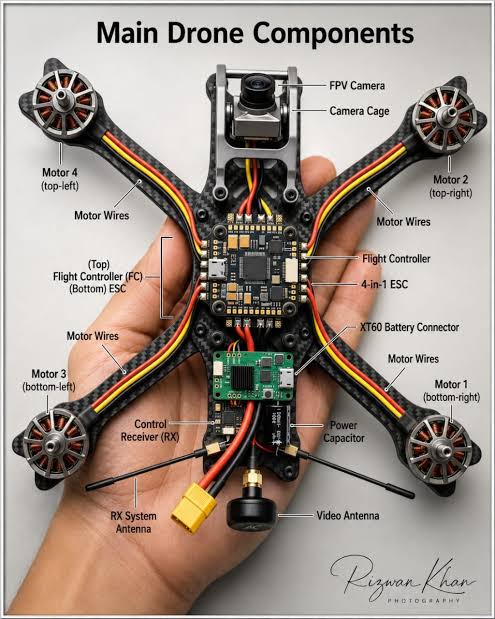
The structural foundation of a high-performance FPV quadcopter relies on a rigid carbon fiber frame that absorbs vibrational stress while housing internal electronics. Power distribution is managed cleanly through heavy-gauge silicone leads terminated by a standard power connector.
XT60 Battery Connector
The robust industry-standard high-current plug that securely links the main lithium-polymer (LiPo) flight battery to the onboard electronics stack.
Power Capacitor
A low-ESR electrolytic capacitor soldered to the main power pads to suppress voltage spikes, absorb electrical noise, and protect sensitive ESC components.
Motor Wires
High-strand silicone wires routing three-phase alternating current from the Electronic Speed Controller out to each brushless motor.
2. Flight Control & Power Processing Stack
Positioned dead-center at the heart of the aircraft is the electronics stack, combining processing intelligence with high-current motor modulation.
Flight Controller (FC)
The "brain" of the drone containing gyroscopes, accelerometers, and a microcontroller running firmware (such as Betaflight or Rotorflight) to calculate stabilization and pilot commands in real time.
4-in-1 ESC (Electronic Speed Controller)
A compact multi-channel board sitting directly beneath or integrated with the FC, responsible for converting DC battery power into precise 3-phase AC signals to drive the four brushless motors.
3. Propulsion System
The quadcopter utilizes four independent brushless motors strategically numbered to coordinate directional thrust and rotational yaw.
Brushless Motors (Motors 1–4)
High-KV electromagnetic motors featuring precision bearings and bell rotors designed to spin multi-blade propellers at extreme RPMs.
4. Radio Control & FPV Video Transmission
Real-time telemetry, pilot control links, and high-definition video feeds are handled by specialized wireless transceivers mounted throughout the rear and front of the chassis.
Control Receiver (RX)
The onboard radio receiver (such as an ExpressLRS module) that receives control inputs transmitted from the pilot's ground transmitter.
RX System Antenna
Flexible dual dipole antennas oriented at 90-degree angles to maintain a rock-solid radio link and eliminate signal polarization dropouts.
FPV Camera & Cage
An armored aluminum camera cage protecting the low-latency digital or analog FPV camera that streams pilot perspective video through goggles.
Video Antenna
A circularly polarized antenna connected to the video transmitter (VTX) to beam crisp real-time flight video back to the ground station.