Autonomous Flight Mission Prep for Corporations
An enterprise-grade operational guide detailing how professional commercial drone flight operators must prepare for field deployments, handle mandatory regulatory filings, utilize digital mission-logging tools, and execute bulletproof field logistics.
Regulatory Compliance: FAA Filing & Airspace Authorization
Executing commercial autonomous flight missions—especially at established municipal or club airfields like Apollo XI—requires strict adherence to Federal Aviation Administration (FAA) regulations under Part 107. Professional operators cannot rely on casual recreational rules.
- Airspace Authorization (LAANC): If your mission site is located within controlled airspace (such as operations near Van Nuys Airport or other commercial airfields), you must secure real-time clearance using the Low Altitude Authorization and Notification Capability (LAANC) via approved service providers before powering up the aircraft.
- FAA DroneZone Registration: Every corporate aircraft (such as commercial identifiers FA3FNRLT4N and FA3FNRY9KM) must be registered under Part 107 in the FAA DroneZone, with physical registration markings displayed prominently on the fuselage.
- Remote ID Compliance: Ensure all autonomous platforms are equipped with operating Remote ID broadcast modules compliant with current FAA mandates unless operating within an approved FRIA (FAA-Recognized Identification Area) under specific sanction rules.
Mission Management & Flight Logging
Corporate drone operations demand a comprehensive audit trail for safety, insurance, and client reporting. Relying on memory or paper notes is unacceptable in commercial environments.
- Digital Flight Logging: Operators should utilize professional flight management platforms such as Aloft (formerly Kittyhawk), Skyward, or DroneLogbook. These apps automatically log telemetry, pilot hours, battery cycle counts, and maintenance logs.
- Pre-Flight & Post-Flight Checklists: Digital apps allow corporate teams to enforce standardized pre-flight risk assessments (GAR forms) and hardware checklist verification before autonomous waypoint execution begins.
Comprehensive Corporate Field Packing List
When deploying to an airfield for complex autonomous mapping, inspection, or delivery testing, missing a single hardware component or spare telemetry cable can result in expensive project delays. The standardized master packing list below is structured from professional enterprise field operations:
| Category | Equipment Item | Operational Purpose / Notes |
|---|---|---|
| Aircraft & Power | Flight pack batteries for FA3FNRLT4N | Primary high-capacity LiPo flight packs for airframe A. |
| Aircraft & Power | Flight pack batteries for FA3FNRY9KM | Primary high-capacity LiPo flight packs for airframe B. |
| Aircraft & Power | DJI to XT60 battery cable adapter | Interface adapter for field charging and power distribution. |
| Aircraft & Power | XT60 Y-Adapter | Parallel/series power splitting for auxiliary ground gear. |
| Control & Telemetry | (2) RC Transmitters | Primary pilot controller and safety pilot buddy-box link. |
| Control & Telemetry | (4) Pucks | Precision ground reference / landing markers. |
| Control & Telemetry | Laptop with Mission Planner loaded | Ground Control Station (GCS) for waypoint planning & telemetry monitoring. |
| Control & Telemetry | SIK Radios | Long-range wireless telemetry link between aircraft and GCS laptop. |
| Control & Telemetry | GPS Locator | Asset tracking and field surveying reference tool. |
| Spares & Electronics | Spare Raspberry Pi | Backup onboard companion computer. |
| Spares & Electronics | Spare GPS compass & holders | Critical navigation redundancy in high-interference environments. |
| Spares & Electronics | Spare sonar sensor | Backup precision altitude/obstacle detection hardware. |
| Spares & Electronics | Spare LCD panel | Field diagnostic display monitor. |
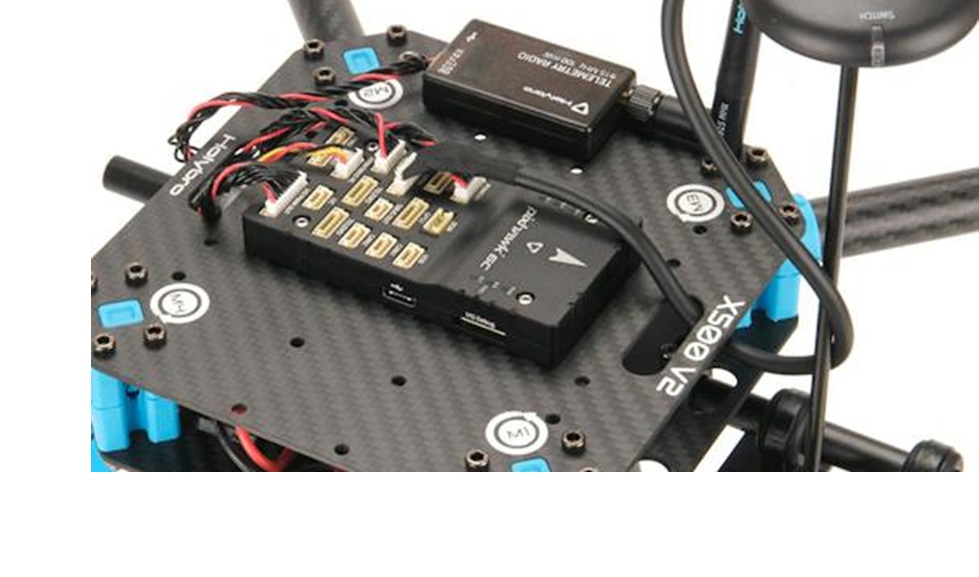
| Spares & Electronics | Spare Pixhawk PX4 | Replacement flight controller unit. |
| Spares & Electronics | Spare props | Rotational spares for field crash/damage recovery. |
| Spares & Electronics | Spare wire & Miscellaneous | Electrical repair stock (solder, heat shrink, wiring loom). |
| Spares & Electronics | Spare phones & iPhone | Mobile hotspots, backup GCS links, and telemetric monitoring devices. |
| Ground Support | Tools: Pliers, Needle Nose, Allen set | Mechanical maintenance and field assembly toolkit. |
| Ground Support | USB cords (micro & USB 2.0) | Data transfer and firmware flashing cables. |
| Ground Support | Landing pads | Dust and debris mitigation during autonomous VTOL operations. |
| Ground Support | IR lock LED | Infrared precision landing beacon guidance hardware. |
| Ground Support | RC Transmitter charger | Transmitter battery management. |
| Ground Support | Generator & Extension Cord | Independent AC power source for field charging stations. |
| Ground Support | Monitor with HDMI port & Charger | Secondary extended display for GCS telemetry dashboards. |
| Ground Support | Power Bank | Portable DC power source for mobile devices and field electronics. |
| Ground Support | Easy-Up Canopy | Weather protection (sun/wind/rain) for ground crew and equipment. |
References & Regulatory Portals
Official portal for registering commercial unmanned aircraft and managing Part 107 operational waivers and authorizations.
Low Altitude Authorization and Notification Capability information for accessing controlled airspace near airports and commercial zones.
Industry-standard enterprise software for automated LAANC approvals, flight logging, and fleet compliance management.
Open-source ground control station software for configuring, planning, and monitoring autonomous ArduPilot/Pixhawk drone missions.