Tabless LiON Batteries
|
Ben Toogood
LiPo Batteries Are About to Be Replaced |
||||||||||||||||||||||||||||||
|
LA Hover Bikes
Tabless LiOn FPV Batteries? |
||||||||||||||||||||||||||||||
|
Joshua Bardwell
Can "Tabless" LiOn Replace LiPo Batteries? |
||||||||||||||||||||||||||||||
|
Why Is This Tabless 21700 Is Better Than Molicel For High Discharge
Lithium Battery Cell Teardown |
||||||||||||||||||||||||||||||
|
Conversation
with GeminiQuestion:I am considering using this battery on this page and building a 6S pack to be used for RC helicopters. Can you total the weight of 6 of these, consider the wiring (likely 10AWG for both pos/neg terminals), the balancer plug and the XT90 and see how much lighter it is than typical 6S 5000mAh lipos? Tenpower 50XG (tabless) Specifications
          Brand                                TENPOWER
          Model                                INR21700-50XG
          Battery Type                         21700 Lithium-Ion (INR)
          Nominal Capacity                     5000mAh
          Minimum Capacity                     4950mAh
          Nominal Voltage                      3.6V
          Full Charge Voltage                  4.2V (max 4.25V)
          Discharge Cutoff Voltage             2.5V
          Max Continuous Discharge             40A (no temp cutoff) / 90A (75°C cutoff)
          Max Pulse Discharge                  140A (3 seconds)
          Standard Charge Rate                 0.5C (2.5A, CCCV)
          Max Charging Current                 15A
          Internal Resistance                  ≤4mΩ (AC 1kHz)
          Cycle Life                           ≥500 cycles (≥60% capacity retention)
          Operating Temperature                Charge: 0-45°C / Discharge: -20-60°C
          Cell Surface Temperature             Discharge up to 80°C
          Battery Top                          Flat Top
          Protected                            No (Unprotected Cell)
          Diameter                             ≤21.50mm
          Length                               ≤70.50mm
          Weight                               ≤71g
Here's the math and the analysis using the Tenpower 50XG specs. Crucially, because these are true 5000mAh cells, you get a direct 1:1 capacity match to a standard 5000mAh LiPo.
Just remember to drop your ESC or telemetry low-voltage warning down toward 2.8V-3.0V per cell so you can actually utilize the full capacity without triggering an early auto-rotation! Important RC Helicopter ConsiderationsWhile the weight savings are massive, you'll want to balance that against a few performance differences: Current Draw (Amps) & Voltage Sag: The 50XG is rated for a massive 90A continuous discharge (with temperature cutoff) or roughly a continuous 10C rate. While they can handle brief bursts higher, standard pouch LiPos routinely push 150A to 250A+ continuous. If you fly aggressive 3D maneuvers, you will notice significant voltage sag and potential overheating. However, for scale flying, sport flying, or aerial photography, they excel. Low Voltage Cutoff (LVC): Li-ion cells can safely pull down to 2.5V or 3.0V per cell under load, whereas standard LiPos shouldn't go below 3.5V. You will need to adjust your transmitter telemetry alerts or ESC cutoff thresholds so you don't trigger an early forced landing. |
||||||||||||||||||||||||||||||
|
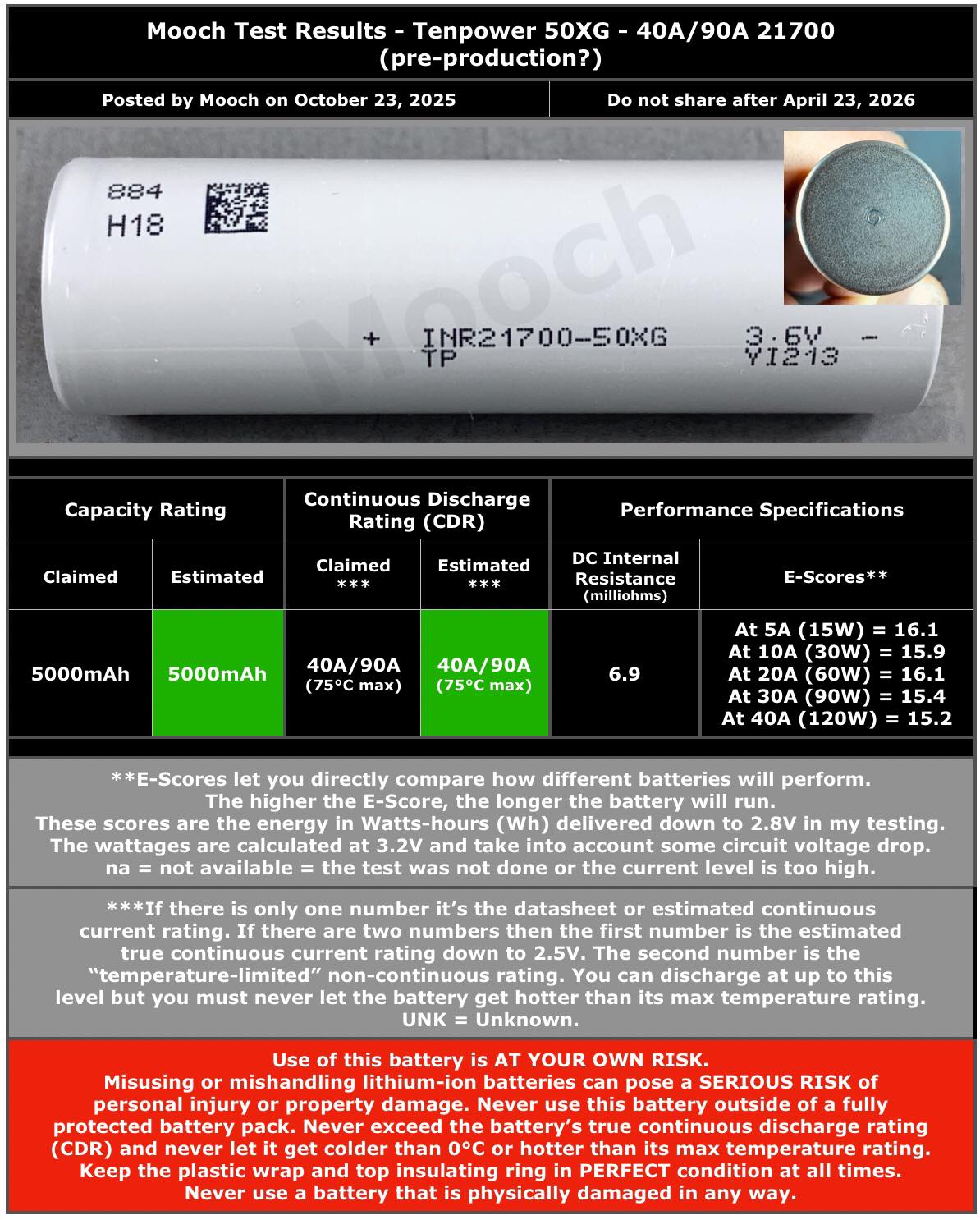
Bench Test Results: Tenpower 50XG (tabless)
40A/90A 5000mAh 21700These tests only note my personal ESTIMATED ratings for these batteries at the time I tested them. Any battery that is "rewrapped" (not in its original factory wrap) can change at any time! This is one of the hazards of using these batteries so carefully research any battery you are considering using before purchasing. Misusing or mishandling lithium-ion batteries can pose a SERIOUS RISK of property damage, personal injury, or even death. They should never be used outside of a fully protected battery pack and you use them at your own risk. Never exceed the battery's true continuous discharge rating (CDR), never let it get colder than 0°C or hotter than 60°C to help lower risk and extend cell life, and keep the plastic wrap and top insulating ring in perfect condition. Never use a battery that is physically damaged in any way. Please read the report before asking any questions: https://tinyurl.com/pa949zxv18650/21700 Ratings & E-Scores and Recommended Batteries Tables:The links are in my public Patreon pinned post: https://www.patreon.com/posts/pinned-post-137974946 I want to work for the community full time! If you feel what I do is worth a couple dollars a month and you would like early access to battery availability, battery and charger testing and news, and a say in what I test, then please consider becoming a patron and supporting my testing efforts: https://www.patreon.com/batterymooch.
|
||||||||||||||||||||||||||||||
|
Conversation
with GeminiQuestion:are all of the batteries on this page considered to be a "tabless" batteries? Yes, all of the batteries listed on this page are considered to be "tabless" lithium-ion cells. The category page you are viewing is explicitly filtered for Tabless Lithium Ion Batteries, and the specific models shown—such as the Ampace JP40, EVE 50PL, and TENPOWER 50XG—are all part of a newer generation of cylindrical 21700 cells designed with tabless architectures. Why Are They Grouped Together?In a standard cylindrical lithium-ion cell, the electrical current flows through a single metal "tab" welded to the copper and aluminum foils inside. This creates a bottleneck for electricity, causing high internal resistance and heat build-up under heavy loads. "Tabless" design (popularized heavily by Tesla's 4680 format and now widely adopted in high-performance 21700 cells like the ones on your screen) removes that narrow tab. Instead, the edge of the foil is laser-slit into a series of tabs or left as a continuous strip that makes contact across the entire end of the roll. What This Means For These Specific Cells:Because they are tabless, these batteries are built for massive power delivery and ultra-high discharge rates without overheating. You can see this directly in their ratings on the page:
Question:which of these batteries would be best to use to build a high performance 6s pack? Building a high-performance 6S1P pack (22.2V nominal) for demanding RC applications like helicopters or high-power EDF jets puts an incredible strain on Li-ion cells. While tabless architecture makes all of these options viable, they are not all created equal when it comes to voltage sag under heavy load, total amp delivery, and capacity balance. Here is how the top contenders from this page stack up against each other for a high-performance 6S build. The Verdict: Which is Best?
Important Build Note for 6S Packs: Because you are assembling these in series to handle high-performance loads, standard nickel strip spot-welding will bottleneck your power. To actually utilize the 50A+ capabilities of these tabless cells, you will want to build the pack using copper-nickel sandwich strips or heavy-duty pure copper busbars to keep connection resistance to an absolute minimum. |
||||||||||||||||||||||||||||||
|
Resources
Note:"Tested by Mooch" refers to the rigorous, objective lithium-ion battery testing conducted by John "Mooch" Muchow. Widely regarded as the industry authority in the vaping, flashlight, and custom electronics communities, his work exposes exaggerated safety ratings by finding the true Continuous Discharge Rate (CDR) and real-world capacity of batteries. Mooch's independent tests help consumers avoid unsafe batteries and get maximum performance out of high-drain devices. You can find his full safety guides, recommended cell rankings, and safety articles across his official testing hubs:
|
||||||||||||||||||||||||||||||