Direct Flight Control (DFC) Rotor Heads Explained
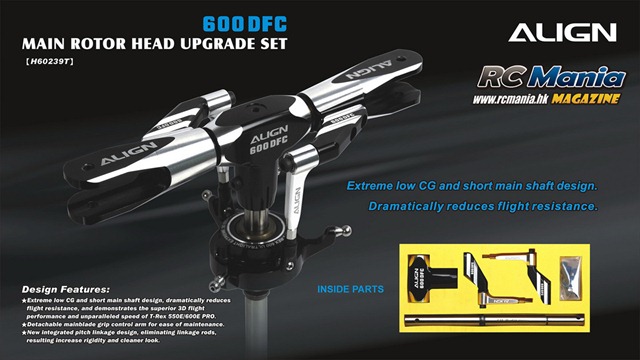
Direct Flight Control (DFC) rotor heads are a specific mechanical implementation of flybarless technology that simplify the linkage between the swashplate and the main rotor grips. They became widely known around 2012 when manufacturers such as Align and SAB introduced DFC-style heads on popular 600-800 class models, marketing them as high-performance solutions for aggressive 3D flying with reduced parts count and a lower rotor disc.
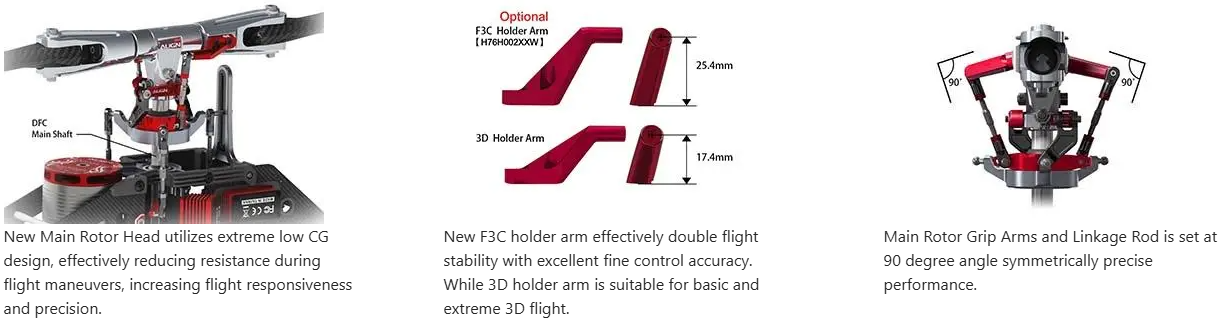
In the RC helicopter community, DFC is now understood less as a new stabilization concept and more as a particular way of driving the swashplate without a traditional washout (swash driver). As one detailed overview puts it, "DFC on the other hand is a mechanically simplified flybarless rotor head linkage system that does away with the washout (also known as the swash driver). In other words, all DFC heads are flybarless, but not all flybarless heads are DFC."
1. What DFC Actually Is (and Is Not)
DFC is an acronym standing for Direct Flight Control flybarless rotor head. Two relatively short, rigid links go directly from the swashplate to the blade grip arms of the main rotor head. At first glance this looks similar to many conventional flybarless heads, but the key difference is in how those upper link ends are constrained.
In a traditional flybarless head with a washout, the swashplate is "driven" by a washout base and arms that rotate with the mast, transmitting rotational loads to the upper swash while still allowing full articulation. The blade grip pushrods themselves already provide a direct linkage between the swashplate and the blade grips: "They still provide a direct linkage between the swashplate and the blade grips - no more or no less so than a DFC linkage."
DFC removes the washout and instead uses the main grip links themselves to drive the swashplate rotationally. Mechanically, it is therefore more accurate to call most DFC heads washout-less flybarless heads rather than a fundamentally different control concept.
2. Basic DFC Linkage Geometry
2.1. Constrained Upper Link Ends
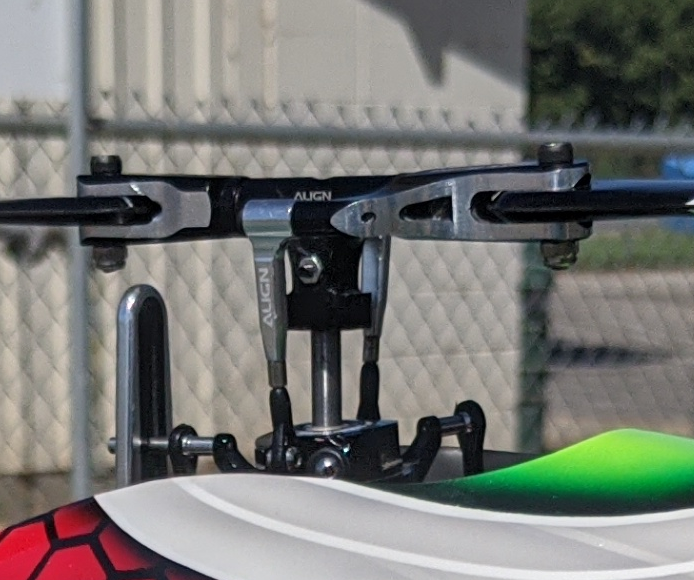
In a DFC head, the upper ends of the links are no longer omnidirectional ball joints. Instead, they rotate only around one axis-typically via a small axle and bearings integrated into the blade grip control arm. This allows:
- Pitch change: The grip can still feather (change blade pitch) around the feathering shaft.
- Lateral load transmission: The link cannot freely pivot like a ball link, so it can transmit lateral (rotational) loads down to the swashplate.
This constrained joint is the defining mechanical feature of DFC. It turns the grip link into a rigid "driver" that keeps the upper swash phased with the rotor head, replacing the function of the washout arms.
2.2. Lower Link Ends and Swashplate Ears
The lower ends of the DFC links still use conventional ball links. There must be at least one fully articulated pivot point in the system to allow the swashplate to tilt and move up and down. Many DFC-specific swashplates therefore have "ears" extending at 90° from the main body, with balls mounted on those ears. This geometry:
- Reduces link pop-off risk: The right-angle placement makes it less likely that centripetal forces will pry the links off the balls.
- Maintains articulation: The swash can still tilt and move vertically while being rotationally driven by the DFC links.
3. Comparison to Modified Bell-Hiller Flybarless Systems
Before DFC became common, many early flybarless conversions simply removed or shortened the Bell-Hiller flybar and used guide arms or special link geometry to keep the swashplate in phase. For example, on the Blade mCP X, the links move within two-pronged guide arms that are part of the main rotor hub, constraining their motion without a separate washout assembly.
DFC can be seen as a cleaner, more integrated evolution of that idea:
- Fewer parts: No separate washout base, arms, or radius links.
- Shorter mast: With the washout removed, the head can be lowered, bringing the rotor disc closer to the helicopter's center of mass.
- Direct drive: The constrained grip links themselves act as the swash driver.
A reported advantage of DFC versus modified Bell-Hiller flybarless systems is precisely this lower rotor disc and reduced mechanical complexity, which together yield a more responsive helicopter for tight 3D maneuvers and crisper flip and roll behavior.
4. Flight Stability and Electronic Control
It is important to emphasize that DFC does not replace the electronic stabilization system. In all modern flybarless helicopters-DFC or otherwise-flight stability is maintained by programmed or programmable 3-axis gyros (flybarless controllers). These units:
- Measure angular rates and sometimes accelerations.
- Drive the cyclic and collective servos to maintain attitude and respond to pilot inputs.
- Compensate for the lack of a mechanical flybar by providing virtual damping and stabilization.
DFC therefore sits purely in the mechanical domain: it changes how the swashplate is driven and how loads are transmitted, but it relies on the same electronic flybarless control principles as any other FBL head.
5. Head Dampening, Feathering Shaft Movement, and "Prying" Forces
5.1. Why Dampeners Become Critical
A commonly reported disadvantage of DFC is the translation of feathering shaft movements directly into the blade grip links. Any up-and-down feathering of the head axle (feathering shaft) tilts the integrated control linkage, turning it into a powerful pry-bar. This can:
- Stress the linkage bearings or bushings.
- Load the bolts or pins at the grip arms.
- Impose lateral forces on the swashplate and ball links.
- Transmit shock loads down into the servos.
As one detailed analysis notes, "any feathering movement of the head axle will tilt the integrated control linkage and that will put large amounts of strain on the linkage itself, the linkage bearings/bushings, the bolt or pin where it attaches to the grip arm, the ball links down at the swashplate, the swashplate, and even down to the servos."
5.2. Stiff Dampening and Large Helicopters
To minimize this prying effect, most large DFC-equipped helicopters use very stiff head dampeners-almost approaching a rigid, undampened setup. This:
- Reduces axle feathering movement to a bare minimum.
- Allows the DFC links to drive the swashplate cleanly without excessive phasing variation.
- Supports high head speeds needed to avoid blade flutter and cyclic wobbles.
However, this stiffness also means higher dynamic loads during flight and less ability to absorb impacts or blade strikes. Many manufacturers eventually moved back to washouts on their larger helicopters because the combination of stiff dampening, high mass linkages, and long blades created too many reliability and maintenance concerns.
5.3. Flexible DFC Link Experiments
Some designs experimented with partially flexible elastomer control linkages to absorb prying forces when the head axle feathered. This reduced stress on the linkages and attachment points and allowed lower head speeds, but introduced its own complexity and potential phasing variation. Most mainstream DFC implementations today remain rigid, making regular dampener and axle play checks a critical pre-flight procedure.
6. Boom Strikes, Scale Fuselages, and Rotor Disc Height
Because DFC heads often sit lower on the mast, the rotor disc is closer to the tail boom. In theory this increases the risk of boom strikes, especially under high disc loading, low head speed, or large collective/cyclic inputs. In practice, boom strikes are influenced by many factors:
- Head speed: Higher RPM increases centripetal force, reducing blade flex and lead/lag.
- Blade bolt torque: Loose blades can lead or lag excessively, tilting down toward the boom.
- Dampener condition: Soft or worn dampeners allow more axle feathering and blade vertical motion.
As far as many pilots are aware, blades striking the boom purely due to the lowered rotor disc is not a dominant issue when head speed, dampening, and blade tension are kept within recommended ranges. Controlled tests have shown that deliberate attempts to cause boom strikes on DFC-equipped models often fail unless multiple adverse conditions are combined.
For scale fuselages, the lowered head can be more problematic: larger-diameter scale booms and horizontal/vertical fins sit closer to the disc, and scale builds typically run lower head speeds. This combination can make DFC less suitable for generic "pod-and-boom into scale fuse" projects unless the mechanics are purpose-designed with lowered booms and flexible grips/blades.
7. Pros and Cons of DFC Rotor Heads
7.1. Pros
- Reduced parts count: No washout base, arms, or radius links. Fewer mechanical components to build, maintain, and wear out.
- Lower rotor disc: Shorter mast and head bring the rotor closer to the helicopter's center of mass, improving cyclic roll and flip rates and giving a more symmetrical feel between upright and inverted maneuvers.
- Crisp cyclic response: Stiff dampening and direct linkage yield very immediate cyclic behavior, which many 3D pilots appreciate.
- Clean aesthetics: Many pilots simply like how DFC heads look-compact, purposeful, and "modern."
- Small/micro heli benefits: On micro and small helicopters, tiny washouts are fragile and sloppy; DFC provides an elegant, robust solution with less drag, weight, and cost.
7.2. Cons
- High sensitivity to dampener wear: Any axle feathering translates directly into prying forces on the DFC links, swashplate, and servos, making dampener condition critical.
- Potential for increased servo and linkage damage: Blade strikes or tip-overs can transmit more force through the rigid DFC links, sometimes stripping servo gears where conventional washout/pushrod setups would sacrifice ball links or rods instead.
- Less forgiving on large helicopters: High mass, long blades, and stiff dampening combine to make DFC more demanding in terms of maintenance and operating envelope; many manufacturers reverted to washouts on 600-800 size machines.
- Scale compatibility issues: Lower rotor disc height can conflict with scale booms and fins, especially at the lower head speeds typical of scale flying.
- Not a unique performance magic bullet: Similar cyclic crispness can be achieved on conventional washout heads by stiffening dampening and running higher head speeds; DFC's advantages are mostly mechanical simplicity and disc height, not fundamentally new aerodynamics.
8. Technical Literature and Terminology Notes
In formal engineering literature, "DFC" more commonly refers to Direct Field-Feedback Control in the context of spherical motors and multi-DOF actuators, not rotor heads. For example, papers such as "Direct Field-Feedback Control for Multi-DOF Spherical Actuators" (Bai, Lee, Foong, IEEE ICRA 2011) and related chapters in Permanent Magnet Spherical Motors discuss direct field-feedback control strategies for precision orientation control.
These works are conceptually interesting-dealing with direct feedback from magnetic fields rather than separate orientation sensors-but they are not directly about RC helicopter rotor heads. In the RC world, "Direct Flight Control" is an industry-adopted acronym for washout-less flybarless heads, and even that term is somewhat misleading: "Even ‘driverless head' is fundamentally incorrect because the swashplate is still being driven, just not by the washout arms. Washout-less is a more accurate description."
9. Practical Takeaways
- Understand the mechanics: DFC is about constrained grip links driving the swashplate, not a new stabilization system.
- Respect dampeners: Regularly check head dampeners and feathering shaft supports for play; DFC is unforgiving of axle movement.
- Match size to design: DFC shines on micro and small helis; on larger machines, weigh the pros and cons carefully.
- Consider your flying style: If you prioritize crisp 3D response and like a clean head, DFC can be appealing. If you value robustness and scale compatibility, a conventional washout may be the better choice.
Ultimately, DFC is a clever mechanical simplification of flybarless rotor heads with specific strengths and trade-offs. Understanding how it works-and where its limits are-lets you decide whether it fits your helicopter, your flying style, and your maintenance habits.