
The Field-Proven VBar / VStabi Flight Tuning Sequence
A comprehensive synthesis of community consensus across HeliFreak, RC Heli Nation, and Mikado VStabi forums on tuning Mikado VBar systems (5.3 Pro, VBar Control, and VBar NEO). This guide outlines the exact, field-tested sequence pilots use to dial in main rotor feel, tail hold, and governor parameters.
Ground Rules & Mechanical Pre-Flight Check
Across all major rotary-wing forums, experts agree: never attempt software tuning to fix a mechanical problem. Before touching a tuning slider in VStabi software or VControl app, verify the following baseline conditions:
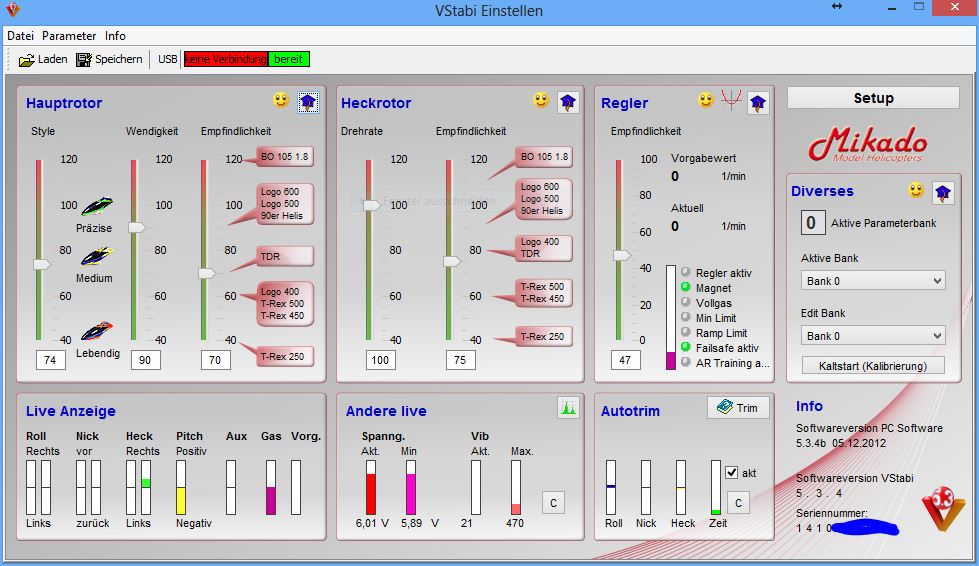
- Mechanical Zero & 8-Degree Setup Geometry: Ensure main blades are tracking at true 0° at mid-stick. During setup step "8 Degrees", measure exactly 8.0° of cyclic pitch with blades parallel to the tail boom. Community Note: Never adjust this value away from 8° to alter flip/roll rates-it serves purely as the internal feedback calibration constant for the VBar control loop.
- Vibration Floor: Run a baseline spectrum analysis or VBar log. Mechanical vibrations from bent tail shafts or imbalanced tail blades will contaminate the P/I loop, resulting in high-frequency tail wag or random elevator bobbles.
- Mechanical Tail Pitch Slider Alignment: Ensure 2° to 3° of anti-torque pitch in the tail rotor at servo mid-point (trailing-edge offset) to prevent tail kick when spooling up.
Master Flight Tuning Roadmap (Step-by-Step Sequence)
-
Phase 1: Establishing Main Rotor Overall Gyro Gain
Goal: Find the maximum cyclic proportional gain before aerodynamic chatter occurs.
- Start with the baseline main rotor gain slider suggested for your airframe size (e.g., ~70-80 for 550/600 class, ~80-90 for 700/800 class).
- Fly fast forward flight (FFF) down the runway at maximum headspeed and execute high-speed power funnels or aggressive pitch pull-ups.
- Adjustment: If the main rotor exhibits a violent high-frequency elevator/aileron chatter (head shake), lower the Main Rotor Gain by 5-point increments until it disappears. If the helicopter feels "loose" or drifts in wind, raise the gain.
-
Phase 2: Tail Rotor Gyro & Pre-Compensation Tuning
Goal: Secure a rock-solid tail hold without high-speed tail wag or collective kickback.
- Common Tail Gain: Perform fast backward flight or high-speed funnels. Increase main tail gain until a fast, violent tail wag appears. Back the slider off 5 points below the wag threshold.
- I-Gain (Heading Hold): Do continuous full-throw pirouettes in fast forward flight. If the piro rate speeds up or slows down depending on heading relative to wind, increase I-gain (Expert menu) until piro speed remains perfectly uniform 360°.
- Tail Stop Gain & Optimizer: Execute hard pirouette stops in both directions (left and right). Turn ON Tail Optimizer. Do 5-10 hard left and right piro stops in a hover. Land, inspect the A and B side optimizer numbers in VStabi software, and turn the optimizer OFF. Adjust "Stop Gain A/B" manually if minor bounce-back remains.
- Torque Pre-Comp (Cyclic & Collective): Do hard vertical pitch-pumps from a hover. If the tail kicks counter-clockwise or clockwise during positive pitch spikes, increase Collective Pre-Comp. To test Cyclic Pre-Comp, perform continuous rapid rolls; adjust until the tail stays locked straight without rotating.
-
Phase 3: Tailoring Cyclic Feel (Style, Agility & Response)
Goal: Customize handling characteristics to match pilot preference without altering control loop stability.
Parameter Function / Community Understanding Recommended Community Range Agility Sets the absolute maximum rotational flip and roll speed at full stick deflection. Acts as your main "rate" controller. 80-90 (Sport / Scale)
100-120 (Aggressive 3D)Style Controls robotic tracking vs. natural flybar feel. Low style (<50) feels soft and paddle-like; high style (>80) feels ultra-locked and robotic. 40-60 (3D / Smack)
70-90 (Precision / F3N)Paddle Simulation Accelerates initial stick entry response without increasing overall rotational rate. Adds "pop" off-center. 0 (Disabled)
20-40 (Snappy 3D entry)Pitch Pump Adds a transient collective boost during rapid stick movements to overcome airframe inertia. 0-20 (Smooth / Scale)
30-50 (Extreme Smack 3D) -
Phase 4: Governor Integration & Feed-Forward Alignment
If using the integrated VBar Governor (Pro / NEO), perform governor tuning only after cyclic and tail gains are finalized:
- Set Governor P and I gains to default baseline.
- Perform hover and medium climb-outs to verify target headspeed matching.
- Adjust Collective Add and Cyclic Add parameters: these feed-forward metrics open the ESC/throttle output preemptively before collective or cyclic pitch loads slow the rotor down.
- Set Cyclic Add to roughly 1/3 of the finalized Collective Add value.
VBar Parameter Glossary Quick Reference
- Main Rotor Gain (P-Gain): Determines how aggressively the cyclic loop resists external force. Too high = rapid head shake; too low = sloppy, wallowy flight path.
- Main Rotor Optimizer: Auto-tunes swashplate control geometry and blade drag differentials during flips, rolls, and piro-flips. Run for 1-2 flights, then lock OFF.
- Tail Stop Gain (Side A / Side B): Controls deceleration damping at the end of a pirouette. Side A handles stop against main rotor torque; Side B handles stop with main rotor torque.
Summary of Community Consensus
The universal consensus among experienced VBar mechanics is to follow a strict top-down sequence: Mechanical Alignment $\rightarrow$ Main Rotor Gain $\rightarrow$ Tail Holding Gain $\rightarrow$ Tail Stop Optimizers $\rightarrow$ Style/Agility Customization. By isolating one parameter at a time and turning off auto-optimizers once values stabilize, pilots achieve the signature "locked-in, on-rails" feel that VBar systems are renowned for.